
Most clothing brands don't fail because of bad designs. They fail because they pick the wrong production partner, or never find one at all. Figuring out how to find a manufacturer for your clothing brand is one of the most critical steps you'll take, and it's also one of the most frustrating. Between vague alibaba listings, unresponsive factories, and confusing MOQ requirements, the process can stall a collection before it even gets started.
The real challenge isn't a lack of options. It's knowing which manufacturer can actually handle your specific needs, whether that's developing samples from a tech pack, sourcing the right fabric, or scaling from a small test run to full bulk production. Getting this wrong costs you time and money. Getting it right gives you a production partner that grows with your brand, and that's exactly the kind of relationship we build at Manludini every day with emerging and established fashion brands.
This guide breaks down the full process step by step: where to search, what to look for, how to vet candidates, and how to evaluate factors like MOQs, communication, and production capabilities. Whether you're launching your first collection or switching manufacturers, you'll walk away with a clear system for finding the right fit, not just any factory willing to take your order.
What you need before you reach out
Most manufacturers drop unqualified inquiries fast. Before you start working through how to find a manufacturer for your clothing brand, you need to have your own details in order. Showing up to a factory conversation without the basics wastes both sides' time and signals that you're not a serious buyer. Getting prepared upfront also speeds up your whole process, from first contact to first sample.
Your tech pack or reference sample
A tech pack is a document that tells a factory everything it needs to know about your garment: measurements, materials, construction details, stitch types, hardware specs, and label placement. Without one, a factory can't price your product accurately, and you won't get a reliable sample back. If you don't have a tech pack yet, a physical reference garment with written notes can work as a starting point, but the more detail you provide, the better your first sample will be.
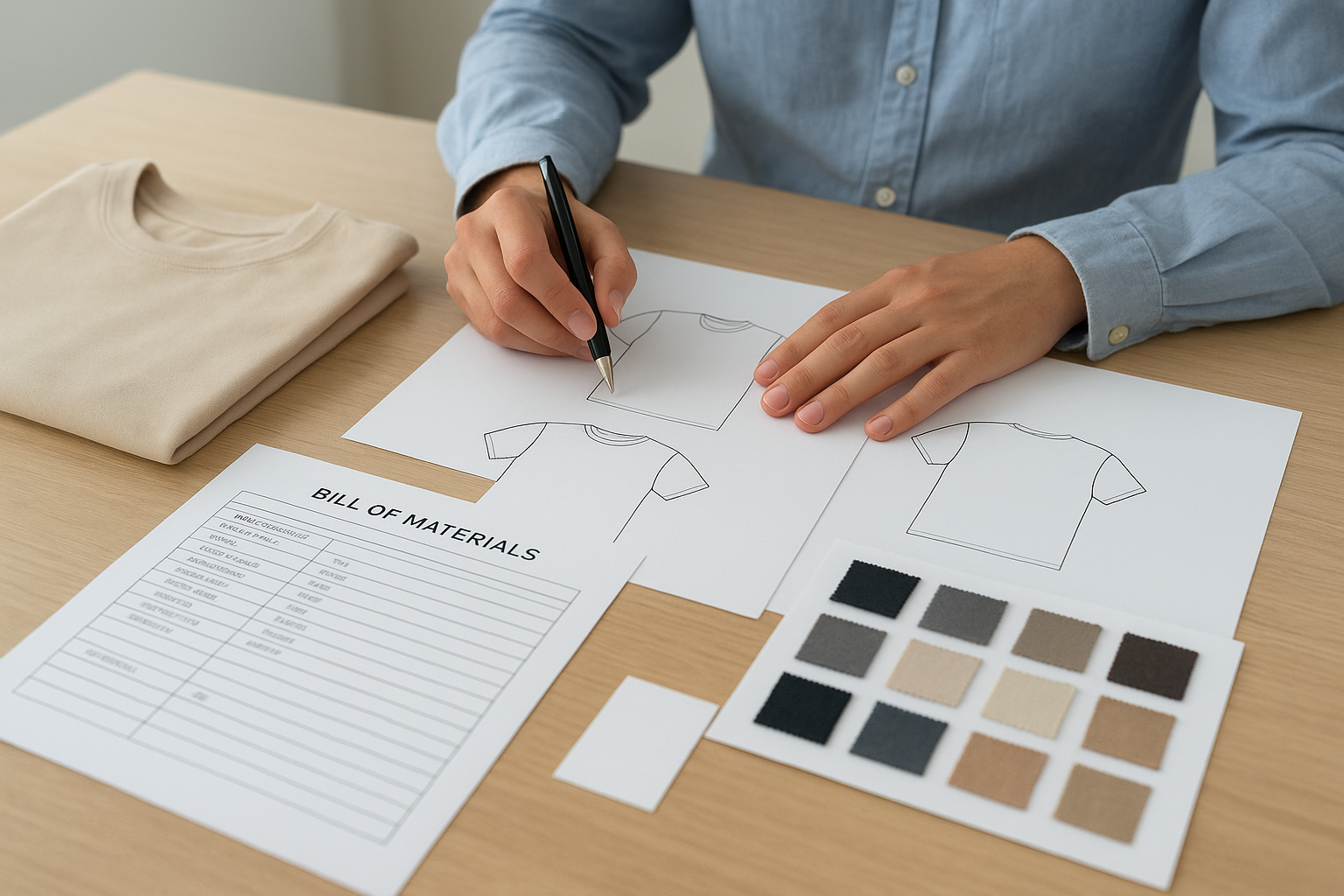
The factories that ask for your tech pack before quoting are usually the ones worth working with. It means they're pricing the actual product, not guessing.
Here's what a basic tech pack needs to cover:
- Sketch or technical flat (front, back, and detail views)
- Bill of materials (fabric type, weight, composition, and color codes)
- Construction details (seam types, stitch counts, and hem finishes)
- Size spec sheet with measurements for each size in your run
- Trim and hardware list (zippers, buttons, labels, tags, and thread colors)
- Care label and branding requirements
Your production numbers
Minimum order quantities matter to manufacturers because they affect how factories schedule production runs and source materials. Before you reach out, decide on the range of units you plan to order, both for sampling and for bulk. You don't need an exact number, but you need a realistic range. Saying "I want 50 units per style" tells a factory something very different from "I want 500 units per style."
You also need a rough target cost per unit in mind. Factories don't expect you to know exactly what something costs before they quote it, but they do expect you to have thought about it. Arriving with no number at all signals that you haven't seriously planned your business, and many factories will deprioritize your inquiry as a result.
Your communication plan
Clear, concise outreach is one of the most underrated parts of working with overseas manufacturers. Before you send your first message, write a short brief covering your brand overview, the product you want to make, your target unit count, your timeline, and any certifications or compliance requirements you need. This doesn't have to be long; a few tight paragraphs with your tech pack attached is enough.
Having a structured list of questions ready also helps you move faster. Decide in advance what you need to know from a factory before committing: their MOQ, sample lead time, bulk production lead time, quality control process, and payment terms. When you contact multiple factories at the same time, this structure lets you compare responses side by side instead of sorting through scattered email threads trying to piece together who said what.
Step 1. Define what you need and can pay
Before you contact a single factory, get your own requirements down on paper. This is the foundational step in how to find a manufacturer for your clothing brand, and skipping it is the most common reason brands get ignored or misquoted. Manufacturers prioritize buyers who know what they want, and showing up with vague details puts you at the bottom of their inbox.
Know your product category and volume
Your product type determines which factories you should even be talking to. A factory that specializes in denim bottoms is set up very differently from one that handles woven shirts or performance activewear. Before you reach out to anyone, write down the exact garment category you're making, the fabric type you plan to use, and any construction details that set your product apart from a basic style.
Volume is just as important to nail down before outreach starts. Use this simple format to map your numbers:
| Stage | Units per style | Approximate timeline |
|---|---|---|
| Sample | 1-3 | Before bulk commitment |
| First bulk run | 100-300 | Within 3-6 months of sampling |
| Repeat bulk | 300+ | Ongoing seasonal orders |
Filling in this table forces you to think through your actual production roadmap, not just a rough launch idea.
Factories that work with 500-unit minimums will not spend time quoting a buyer who needs 50 units. Knowing your numbers upfront keeps you from contacting the wrong manufacturers entirely.
Set a realistic unit cost target
Your target cost per unit should come from your retail price and margin math, not from what you hope to pay. A simple starting point: if your retail price is $80, your cost of goods should land between $16 and $24 to support standard wholesale and retail margins. That range gives you a concrete number to reference when a factory asks what your target price is.
Payment terms are another area to understand before quoting begins. Most overseas manufacturers require a 30-50% deposit before sampling or production starts, with the remaining balance due prior to shipment. Knowing this in advance lets you plan your cash flow and avoid getting caught off guard when a factory sends over their standard contract.
Step 2. Build a shortlist using the right channels
Once you have your requirements documented, the next step in how to find a manufacturer for your clothing brand is identifying where to actually find candidates. Not all sourcing channels produce the same quality of leads, and spreading your search across multiple channels gives you a stronger shortlist to work from than relying on a single source.
Online directories and trade platforms
Online sourcing platforms are the most accessible starting point for most brands. Alibaba, Global Sources, and Maker's Row all list thousands of manufacturers, but volume doesn't equal quality. When you search these platforms, filter by verified supplier status, production capability, and response rate rather than browsing by price alone. Look at how long a supplier has been on the platform, read through buyer reviews, and check whether their listed product categories actually match your garment type.
A factory that has been active on a platform for five or more years with consistent reviews is a much safer starting point than a new listing with no transaction history.
Here are four sourcing channels worth prioritizing:
- Online B2B directories: Alibaba, Global Sources, and Maker's Row for broad manufacturer searches
- Trade associations: The American Apparel & Footwear Association (AAFA) and similar industry bodies often maintain supplier resources for members
- LinkedIn outreach: Search for sourcing agents, factory representatives, or production managers in your target manufacturing region
- Referrals from other brands: Ask founders in non-competing categories who they use; a direct referral cuts your vetting time significantly
Trade shows and direct referrals
Trade shows remain one of the most reliable ways to build a factory shortlist because you meet production teams in person, see fabric and trim samples directly, and have real conversations without email filters in the way. MAGIC in Las Vegas and Texworld USA in New York are two larger US-based events where domestic and international manufacturers exhibit regularly.
When you attend, bring printed copies of your tech pack and a short one-page brand overview. Factories at trade shows speak with dozens of buyers per day, so arriving organized immediately sets you apart. Collect business cards, take notes on each conversation, and follow up within 48 hours while the details are still fresh.
Step 3. Vet factories with a repeatable checklist
Once you have a shortlist of candidates, the critical part of how to find a manufacturer for your clothing brand is filtering that list down to factories worth serious time. Vetting isn't just about asking if a factory can make your product. It's about testing how they communicate, how they handle details, and whether their production capabilities match your actual requirements.
Check communication quality first
Your first message to a factory is also a test. How quickly they respond and how thoroughly they answer your questions tells you a lot about how production will go. A factory that replies in vague sentences, ignores half your questions, or takes two weeks to send a basic response is not going to get better once your money is on the table. Responsiveness and clarity early in the conversation are strong signals of how the relationship will actually function.
If a factory can't answer your initial inquiry clearly, don't expect sharper communication once sampling starts.
Ask the right questions about production
When you reach a factory's sales or sampling team, send the same core questions to each candidate so you can compare answers directly. This keeps your evaluation consistent across your shortlist.
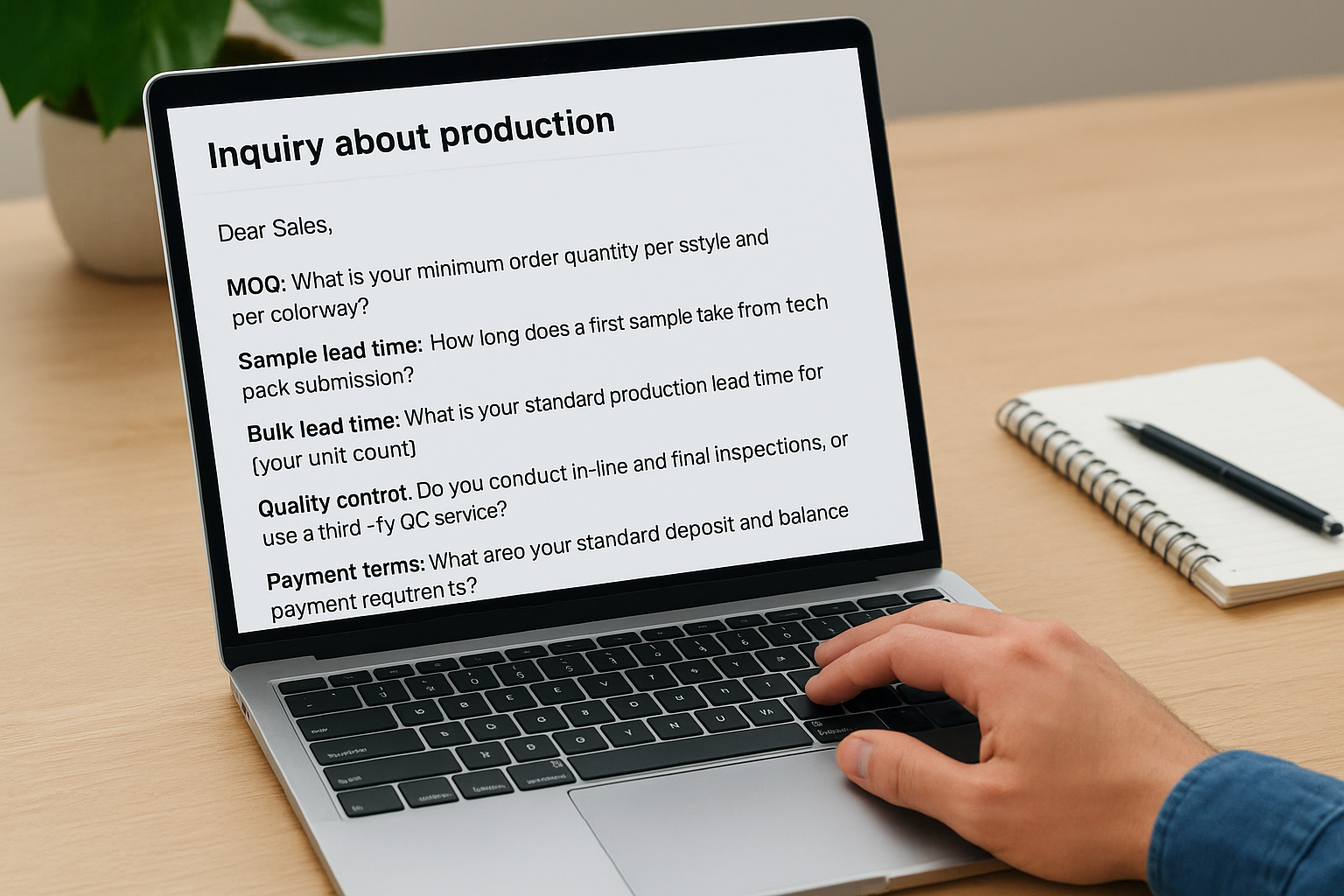
Use this template as your opening inquiry follow-up:
- MOQ: What is your minimum order quantity per style and per colorway?
- Sample lead time: How long does a first sample take from tech pack submission?
- Bulk lead time: What is your standard production lead time for [your unit count] units?
- Quality control: Do you conduct in-line and final inspections, or use a third-party QC service?
- Payment terms: What are your standard deposit and balance payment requirements?
- Certifications: Do you hold any compliance certifications relevant to [your target market]?
Score each factory side by side
Gut feel isn't a vetting system. After you collect answers from each factory, score each candidate across the same criteria so you can compare them objectively. Build a simple table like this:
| Factory | MOQ fit | Response time | Sample lead time | QC process | Overall score |
|---|---|---|---|---|---|
| Factory A | 4/5 | 5/5 | 3/5 | 4/5 | 16/20 |
| Factory B | 3/5 | 3/5 | 4/5 | 3/5 | 13/20 |
Filling in this table removes emotion from the decision and makes it straightforward to move forward with the top two or three candidates for sampling.
Step 4. Sample, quote, and lock the deal
This is where the practical work of how to find a manufacturer for your clothing brand turns into an actual production agreement. You've vetted your shortlist, you've scored each factory, and now you need to move your top two or three candidates through sampling before you commit your budget to anyone.
Order and review your samples
Request a pre-production sample (PP sample) from each of your top two or three factories at the same time. Running parallel samples is more expensive upfront, but it protects you from losing four to six weeks if your first choice delivers an unusable result. When you submit your tech pack, include a clear revision note flagging any details you know are tricky, such as specific seam construction, fabric weight tolerances, or label placement.
When your samples arrive, evaluate them against a fixed list rather than general impressions:
- Measurements: Check every spec point against your size sheet and note deviations in millimeters
- Fabric and trim: Confirm composition, weight, and color match your bill of materials exactly
- Construction quality: Check seam strength, stitch count, and hem evenness
- Labels and branding: Verify placement, print quality, and content accuracy against your spec
A factory that nails your first sample with minimal notes is worth paying slightly more per unit than one that needs three rounds of corrections to get close.
Lock in your quote and production terms
Once you approve a sample, ask the factory for a formal production quote in writing. This quote should cover your unit price, total order value, packaging specs, and any additional charges for custom labeling or special finishes. Do not accept a verbal or informal estimate; you need a written document you can reference if anything shifts later.
Before you sign off on a purchase order, confirm the following terms in writing:
- Deposit amount and payment schedule (typically 30-50% upfront, balance before shipment)
- Bulk production lead time with a specific delivery window included
- Quality inspection process and who carries responsibility for final approval
- Revision and defect policy covering what happens if bulk units fall outside your accepted tolerance
Getting these terms confirmed before you transfer any funds protects both sides and removes ambiguity from the entire production timeline.
Next steps
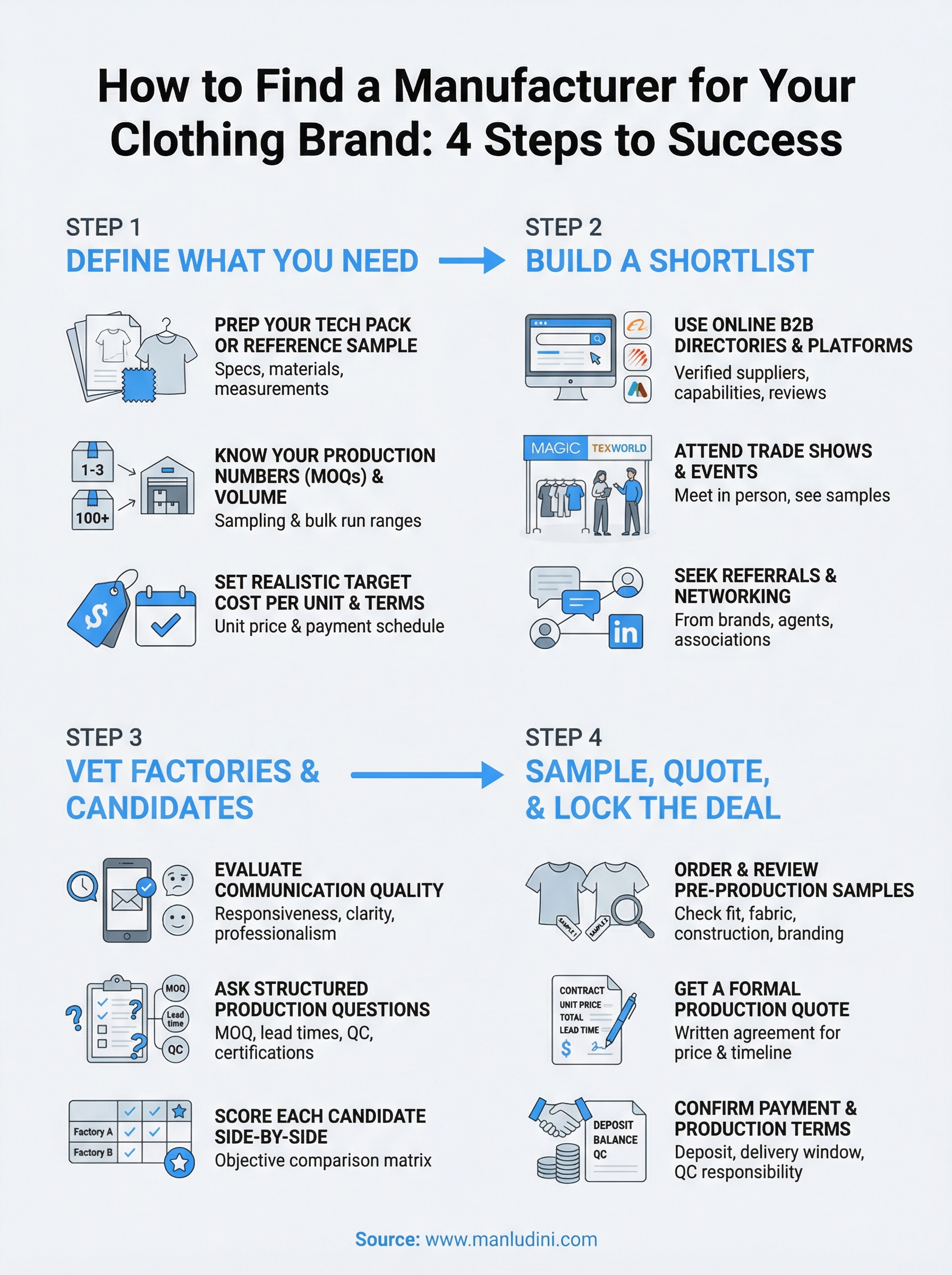
You now have a complete system for how to find a manufacturer for your clothing brand: prep your materials, define your numbers, build a shortlist across multiple channels, vet candidates with a repeatable checklist, and lock in your terms before any money moves. Each step builds on the last, so skipping ahead typically means going backward later.
The most common mistake brands make at this stage is waiting until everything feels perfect before reaching out to a factory. Start your outreach now, even if your tech pack still needs work. Real conversations with real manufacturers will sharpen your spec faster than another week of internal planning ever will.
If you're ready to move from research to actual production, Manludini works directly with fashion brands at every stage, from first sample to bulk manufacturing. Start your production inquiry with Manludini and get a direct response from a team that handles the full process.
0 comments