
Fabric is the foundation of every garment you'll ever produce. Pick the wrong supplier or skip quality checks, and you'll deal with delayed timelines, inconsistent rolls, and products that don't match your samples. Understanding how to source fabric for clothing correctly can save you months of back-and-forth, and thousands of dollars in wasted development costs.
But here's the thing: most guides on fabric sourcing stay surface-level. They'll tell you to "visit a trade show" or "search online directories" without walking you through what actually matters, evaluating suppliers, negotiating MOQs, checking fabric quality before committing to bulk, and building a sourcing process that holds up across multiple production runs. That's what this guide covers, step by step, based on real manufacturing workflows we see every day.
At Manludini, we work directly with fashion brands on everything from sample development to bulk production, and fabric sourcing is one of the first conversations we have with almost every client. Whether you're launching your first collection or scaling an existing line, the supplier relationships and quality checks you set up now will shape your entire production process. Below, we break down how to find reliable fabric suppliers, handle minimum order quantities, and build a quality control routine that actually protects your brand.
What fabric sourcing covers and why it matters
Fabric sourcing is not just about finding a material you like online and placing an order. It covers every step between identifying the right fiber, weight, and construction for your design and getting usable rolls delivered to your production facility on time. That includes researching supplier types, requesting swatches, negotiating pricing and minimums, running quality checks, and confirming compliance with labeling or safety standards your market requires. For brands figuring out how to source fabric for clothing for the first time, the full scope of this process often comes as a surprise.
What the sourcing process actually involves
Most brands assume sourcing ends when they find a fabric they like. In practice, the discovery phase is just the beginning of a longer workflow that runs in parallel with your sample development. You still need to confirm the supplier can hit your target price at the quantity you need, that they carry consistent stock across dye lots, and that their lead times align with your production schedule. Skipping any of these steps creates risk that surfaces later, usually during bulk production when it is far harder to fix.
The sourcing process typically moves through these stages:
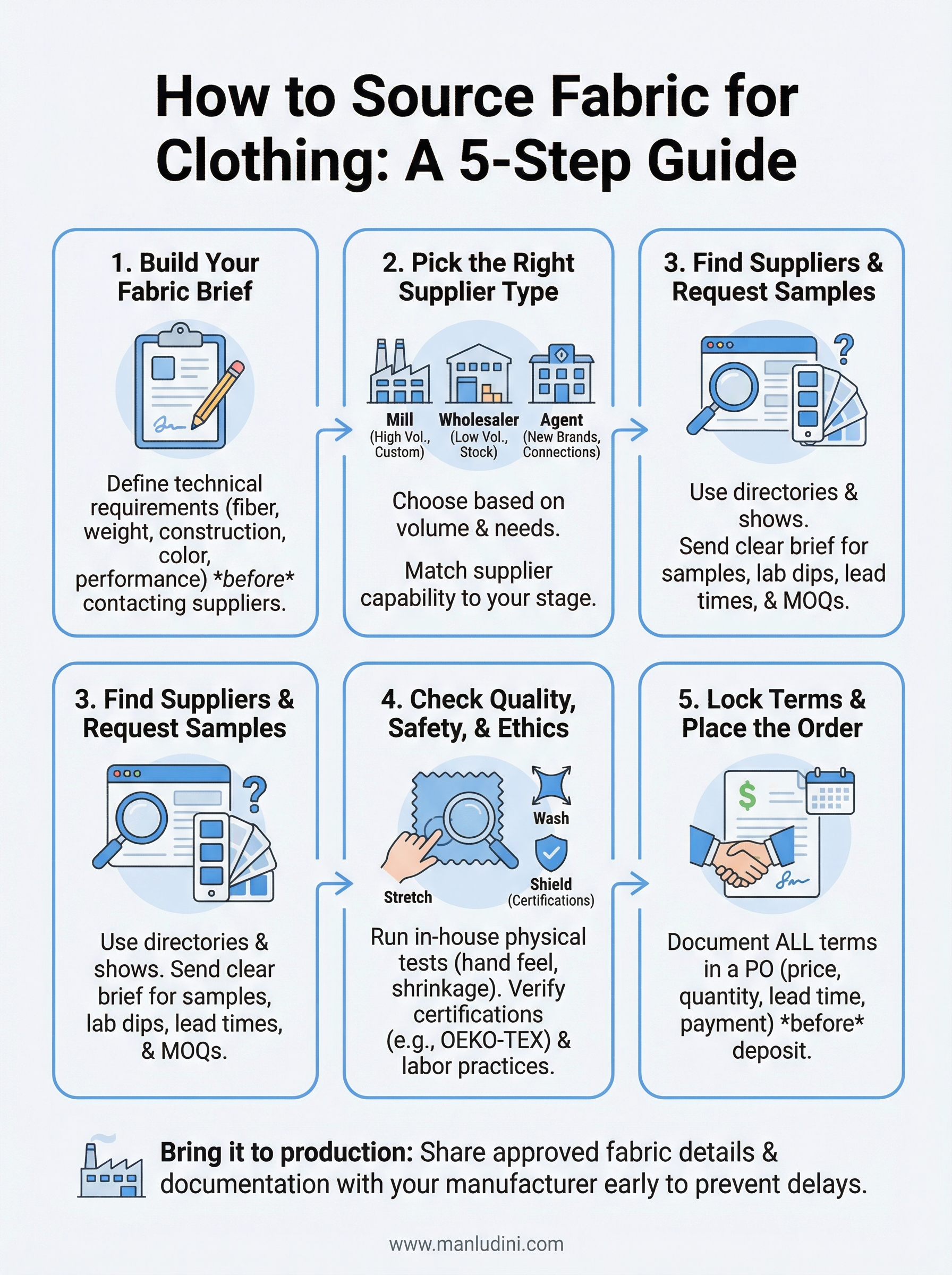
- Brief creation: defining fiber, weight, weave, finish, and performance requirements before you contact any supplier
- Supplier identification: finding mills, wholesalers, or agents that match your volume and quality expectations
- Sample requests: ordering swatches or lab dips to test color, hand feel, and fabric construction
- Quality checks: testing the fabric against your technical specification before approving bulk
- Order placement: locking in pricing, quantity, delivery terms, and payment conditions
Each stage carries its own variables, and a problem in one will ripple forward into the next.
Why sourcing decisions shape your entire product
Every choice you make at the fabric sourcing stage has a direct effect on garment performance, production cost, and delivery timeline. A fabric with inconsistent shrinkage will cause fit problems after the first wash. A supplier with poor lot-to-lot color control will produce mismatched pieces within the same order. And a mill that cannot meet your minimum order quantity forces you to either buy more than you need or find an alternative mid-development, which resets your timeline entirely.
The fabric you approve at the sample stage sets the standard your bulk production will be measured against. If that standard is wrong, no amount of downstream quality control will fix it.
Brand reputation is also tied directly to your fabric sourcing decisions. Your customers experience the fabric before they read a label or look at a price tag. If the hand feel is off, if the fabric pills after two washes, or if the color fades unevenly, that outcome traces back to a sourcing choice made early in development. Getting the right fabric in place before bulk begins protects everything that follows, including your margins, your relationships with buyers, and your ability to reorder consistently across multiple seasons.
Where sourcing fits in the broader production process
Fabric sourcing does not happen in isolation. It runs alongside tech pack development, trim selection, and factory communication, which means delays in sourcing push back everything else. Brands that treat fabric sourcing as a parallel track rather than a step that happens after design approval consistently hit their sampling timelines more reliably. If you are working with a manufacturing partner, sharing your fabric brief early gives them the opportunity to cross-reference options they already have access to through existing mill relationships, which can reduce both cost and lead time significantly.
Step 1. Build your fabric brief
A fabric brief is the document you put together before you contact any supplier, and it defines your exact technical requirements in one place. Without one, you'll get back wildly different samples, waste weeks chasing options that don't fit your design, and restart conversations every time a new supplier asks the same basic questions. Writing this document first is the single habit that separates brands that move efficiently through sampling from those that don't.
What your brief should specify
Your brief needs to cover both the physical properties of the fabric and the performance requirements your garment calls for. Vague requests like "soft cotton jersey" produce vague results. The more specific you are, the faster a supplier can tell you whether they have a match, and the more useful their samples will be when they arrive.
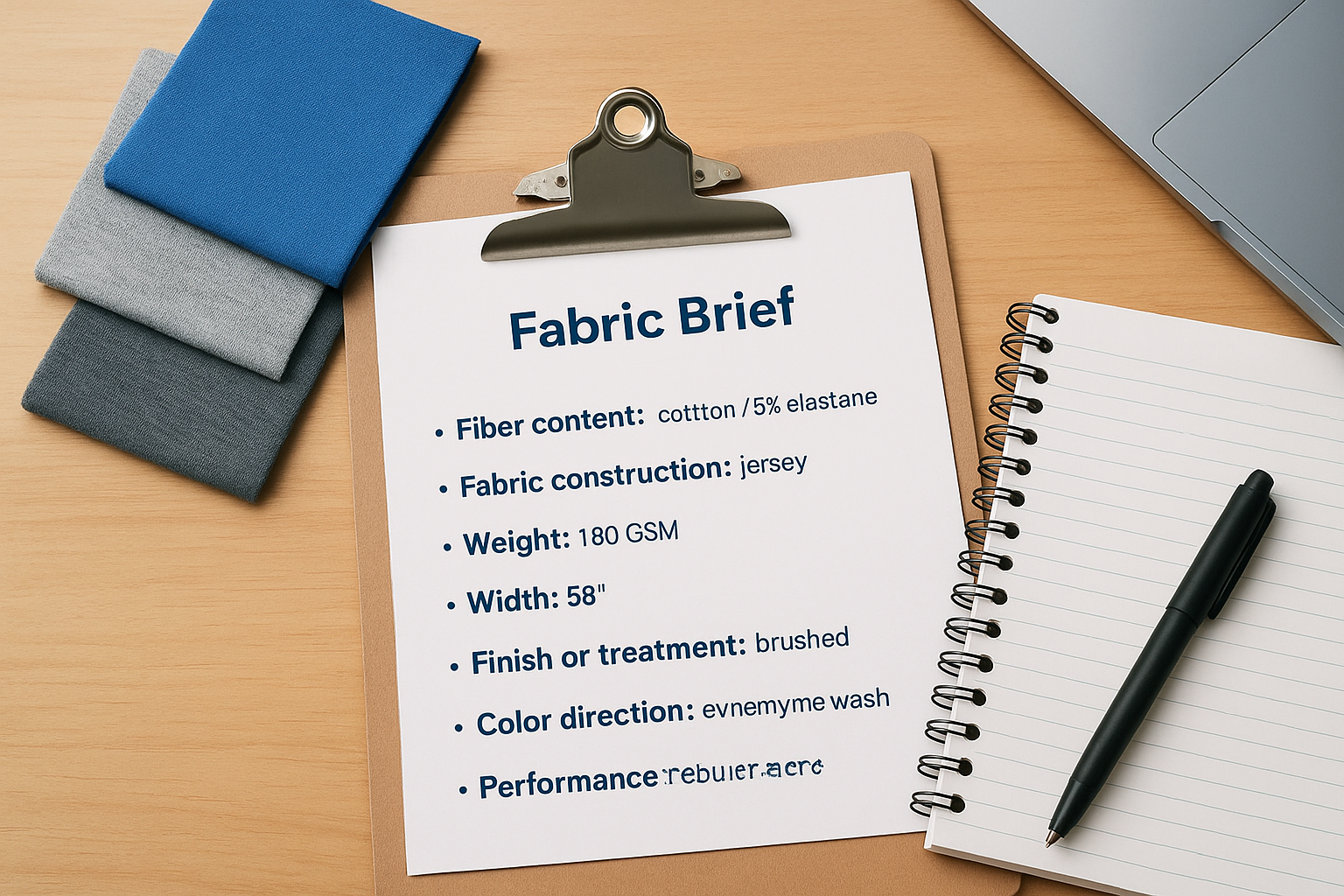
A well-written fabric brief cuts your sample approval rounds in half because suppliers start with accurate targets instead of guessing what you need.
Include these details in every brief you send:
- Fiber content: for example, 95% cotton / 5% elastane
- Fabric construction: jersey, twill, poplin, fleece, dobby, etc.
- Weight: expressed in GSM (grams per square meter), such as 180 GSM
- Width: typically 44", 58", or 60"
- Finish or treatment: brushed, enzyme washed, water-repellent, preshrunk
- Color direction: Pantone reference or color family
- Performance needs: stretch recovery, colorfastness, shrinkage tolerance
- End use: outerwear, activewear, or casualwear, so the supplier can flag concerns early
Fabric brief template
Copy and adapt this template when reaching out to suppliers as part of figuring out how to source fabric for clothing in a way that keeps your development timeline on track:
Fabric Brief

Brand: [Your brand name]
Season / Collection: [e.g., Fall 2026]
Garment type: [e.g., pullover hoodie]
Fiber content: [e.g., 80% cotton / 20% polyester]
Construction: [e.g., French terry]
Weight: [e.g., 320 GSM]
Width: [e.g., 58"]
Finish: [e.g., brushed interior, enzyme wash]
Color: [e.g., Pantone 19-4024 TCX or Navy]
Certifications needed: [e.g., OEKO-TEX Standard 100]
Target price per meter: [e.g., USD 4.50-5.50]
Required quantity: [e.g., 500 meters per color]
Target delivery: [e.g., June 15, 2026]
Sending this document upfront signals that you are a serious, organized buyer and makes the supplier's job easier, which typically gets you faster responses and more accurate samples from the start.
Step 2. Pick the right supplier type
Not every fabric supplier operates the same way, and choosing the wrong supplier type for your volume and development stage is one of the most common mistakes brands make early on. Some suppliers work only with high-volume buyers, while others specialize in smaller runs or pre-stocked options. Understanding the difference between mills, wholesalers, and agents before you start reaching out will save you time and prevent mismatched expectations around pricing and minimum order quantities.
Mills, wholesalers, and agents compared
Each supplier type comes with a different cost structure and minimum order requirement, and the level of customization available varies significantly across them. The right choice depends on your current order volume, how much control you need over fiber content and construction, and whether your timeline allows for development rounds.

If you are still figuring out how to source fabric for clothing at scale, starting with a wholesaler or agent often makes more sense than going straight to a mill.
| Supplier type | Best for | Typical MOQ | Custom options |
|---|---|---|---|
| Fabric mill | Brands with established volume | 500-3,000+ meters | Full: color, weight, finish |
| Wholesaler | Small to mid-sized brands | 50-300 meters | Limited to existing stock |
| Trading company / agent | Brands new to overseas sourcing | 100-500 meters | Moderate, mill-dependent |
| Online marketplace | Sampling and small runs | 1-10 meters | Pre-made fabrics only |
When to go direct and when to use an agent
Going directly to a mill gives you better unit pricing and full control over fabric development, including custom colorways, weights, and finishes. The trade-off is that most mills require at least 500 meters per colorway, which only makes sense once you have confirmed demand and stable reorder patterns across your line. For a new style or a first production run, that level of commitment carries real financial risk.
Using a trading company or sourcing agent is a more practical entry point if you are newer to overseas procurement. Agents already have established relationships with multiple mills, speak the local language, and can consolidate smaller orders across different fabric types into a single workflow. You pay a margin for that service, but you also reduce the communication gaps and sourcing errors that show up as cost later.
Wholesalers are the right fit when you need fabric quickly and do not require custom construction or dyeing. Their inventory is pre-woven and pre-dyed, which keeps lead times short, but limits your design options to whatever they have in stock at that moment.
Step 3. Find suppliers and request samples
Once your fabric brief is ready, you can start identifying suppliers who match your volume, quality requirements, and timeline. This step involves more than running a quick search online, and the way you approach your first contact with a supplier will directly affect the quality and speed of the samples you receive. Knowing where to look and what to say from the first message makes the whole process move faster.
Where to find fabric suppliers
Trade directories and sourcing platforms are your most practical starting points when figuring out how to source fabric for clothing at scale. Platforms like Alibaba list thousands of fabric mills and trading companies, and you can filter by product type, minimum order, and certification. For in-person sourcing, fabric trade shows such as Première Vision (Paris), Texworld, and Intertextile Shanghai let you handle swatches directly and meet supplier representatives face to face, which speeds up trust-building significantly.
Meeting a supplier in person at a trade show is still one of the fastest ways to qualify them, because you get to evaluate communication quality and product range in the same conversation.
Beyond trade shows and directories, referrals from your production partner or factory are worth prioritizing. Manufacturers often have existing relationships with mills they already trust, which means they can pre-screen options against your brief before you spend time on back-and-forth messages.
How to request samples the right way
When you contact a supplier, attach your fabric brief directly to the first message and be explicit about what you need from them. A clear request reduces the number of rounds it takes to get to a usable sample. Use this template as your starting point:
Subject: Fabric Sample Request – [Your Brand Name]

Hi [Supplier Name],

We are a fashion brand looking to source fabric for an upcoming production run.
Please find our full fabric brief attached.

We would like to request:
- 1-2 meters of the closest available option, or a swatch card
- Your standard lead time for bulk orders
- MOQ per colorway
- FOB price at [your target quantity] meters

If you need a lab dip based on our Pantone reference, please confirm your lab dip fee and turnaround time.

Thank you,
[Your Name]
[Brand / Company]
[Email / WhatsApp]
Always ask for lab dip turnaround and bulk lead time in the same message so you can compare suppliers on both quality and timeline from the start.
Step 4. Check quality, safety, and ethics
Receiving fabric samples is not the finish line. Before you approve anything for bulk, you need to run your own checks on what arrived and confirm the supplier meets the compliance and labor standards your market requires. Skipping this step is where a lot of brands learn expensive lessons, and it is one of the most critical parts of knowing how to source fabric for clothing in a way that holds up across multiple production runs.
Run physical and performance tests on every swatch
Every swatch you receive should go through a basic set of physical checks before it earns a bulk approval. You do not need a commercial testing lab for initial screening. You can run several meaningful tests in-house using simple materials.
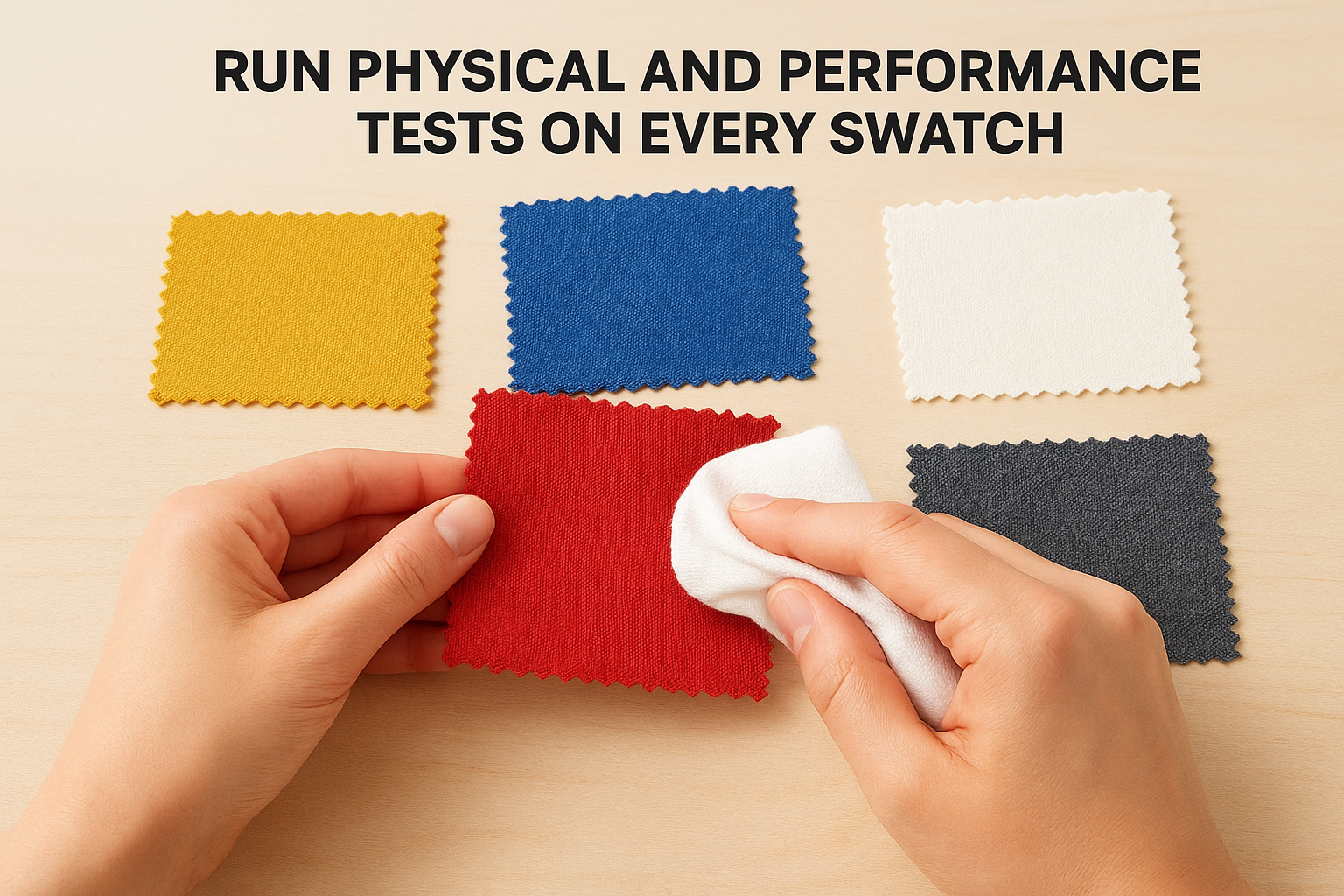
If a fabric fails your in-house tests at the sample stage, it will fail in the hands of your customer, and at that point the cost is far higher.
Work through this checklist on each swatch you receive:
- Hand feel: Does it match your brief? Fabric that feels rougher or thinner than expected will not improve in bulk.
- Stretch and recovery: Pull the fabric across the grain, hold for five seconds, and release. It should return to its original shape without distortion.
- Colorfastness: Dampen a white cloth and rub it against the fabric. Any visible color transfer signals a problem.
- Shrinkage: Cut a 30cm x 30cm square, wash it at your garment's care temperature, and measure again. Note any change.
- Pilling: Rub two pieces of the fabric together for 30 seconds and check the surface for fiber balling.
Confirm certifications and compliance requirements
Regulatory and safety requirements vary depending on where you sell and who you sell to. Childrenswear, activewear, and products entering the US or EU markets often require specific certifications. OEKO-TEX Standard 100 is the most widely recognized certification confirming that a fabric has been tested for harmful substances, and many buyers now require it as a baseline.
Ask your supplier for a copy of their current certification before you place any bulk order. If they cannot provide documentation, treat that as a red flag and request third-party lab test results instead.
Evaluate labor and sourcing practices
Ethical sourcing is no longer optional for most retail buyers and consumers. When you request supplier documentation, also ask about their labor policies, factory audit history, and raw material traceability. A supplier that sources sustainably and can provide audit reports from recognized programs is far less likely to create compliance problems for your brand down the line.
Step 5. Lock terms and place the order
Once your fabric passes quality checks, the next step is converting your supplier conversation into a formal agreement. Verbal confirmations and email threads are not enough to protect you if something goes wrong between approval and delivery. Before any payment changes hands, you need every key term documented in writing so both sides are working from the same expectations.
Locking terms in writing before you pay is one of the simplest ways to avoid the most common disputes brands face when learning how to source fabric for clothing for the first time.
What to confirm before you pay
Every purchase should come with clear written confirmation of the following points before you release a deposit. If a supplier pushes back on documenting any of these, treat that as a reason to pause and ask more questions before moving forward.
- Price per meter: confirmed at your approved quantity, not a range
- Total quantity: in meters, with an acceptable overage or underage tolerance (typically plus or minus 3-5%)
- Color standard: Pantone reference or approved lab dip number
- Lead time: the date bulk fabric ships from the supplier, not the arrival date at your factory
- Payment terms: deposit percentage, balance trigger, and accepted payment method
- Packaging: roll length, core type, and any labeling requirements
- Incoterms: FOB, CIF, or EXW, which determines who covers shipping and insurance costs
Getting all of this in writing before you transfer funds protects you if a dispute comes up around price, quantity, or delivery date. A confirmed email thread works, but a formal purchase order is better.
Use a purchase order document
A purchase order (PO) keeps the transaction clear and gives you a reference document for every production run you place. Use this template as your starting point and adapt it to each supplier:
Purchase Order

PO Number: [e.g., PO-2026-001]
Date: [e.g., April 10, 2026]
Buyer: [Your brand name and address]
Supplier: [Supplier name and address]

Fabric description: [e.g., 80% cotton / 20% polyester French terry, 320 GSM, 58"]
Color: [e.g., Pantone 19-4024 TCX, approved lab dip #LD-007]
Quantity: [e.g., 500 meters +/- 5%]
Unit price: [e.g., USD 5.20 per meter]
Total value: [e.g., USD 2,600]
Incoterms: [e.g., FOB Guangzhou]
Payment terms: [e.g., 30% deposit, 70% before shipment]
Shipment date: [e.g., June 15, 2026]
Destination port: [e.g., Los Angeles, CA]
Send this document to your supplier and ask for a signed copy before releasing your deposit. Keep both the signed PO and all related email confirmations in a dedicated folder for that production run so you have a complete paper trail if anything needs to be resolved later.
Bring it to production
Knowing how to source fabric for clothing is only half the work. The other half is making sure the fabric you approved at the sample stage actually makes it into production without surprises. Once your purchase order is confirmed and your bulk rolls are on their way, share your fabric details and supplier documentation with your production partner early so they can flag any fit, shrinkage, or construction concerns before cutting begins.
Building a fabric sourcing process that you repeat across every collection takes time upfront, but it creates a reliable foundation you can scale. Every brief you write, every supplier you qualify, and every purchase order you document makes your next development cycle faster and lower risk. If you are looking for a manufacturing partner who can support your production from sample development through bulk, work with Manludini to move your next collection forward with fewer gaps and more control.
0 comments