
Every garment that reaches a consumer carries more than fabric and stitching, it carries information. What are clothing labels? They're the small but critical tags sewn into or printed onto garments that communicate everything from brand identity to fiber content, care instructions, country of origin, and sizing. Whether you're launching your first collection or scaling production, understanding clothing labels is essential to getting your product retail-ready and legally compliant.
Labels also play a bigger role than most new brands expect. Beyond meeting regulatory requirements set by bodies like the FTC, they shape how customers perceive and interact with your product. A well-executed label system builds trust, reinforces branding, and keeps you out of legal trouble. A sloppy one does the opposite, and costs time and money to fix mid-production.
At Manludini, we work with fashion brands through every stage of garment manufacturing, including custom label development, private labeling, and trim coordination. This article breaks down the main types of clothing labels, what information they need to include, and the legal requirements you should know before your garments hit the market.
Why clothing labels matter to brands and buyers
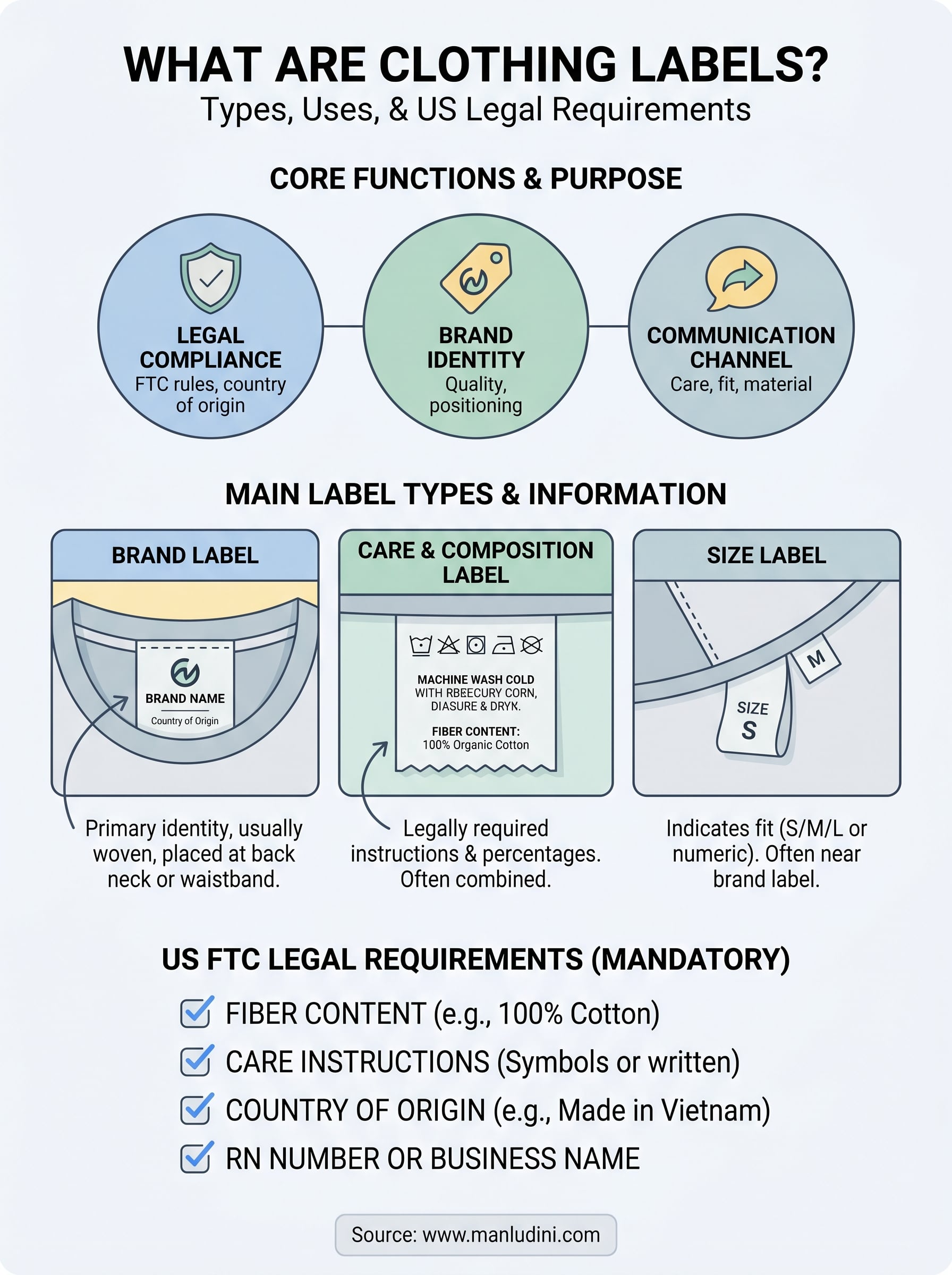
When you ask what are clothing labels, the answer goes beyond a simple tag sewn into a seam. Labels are a legal requirement, a branding tool, and a communication channel between your product and the person wearing it. Getting them right means your garments meet market standards, connect with customers, and move through retail without delays or costly rejections.
A missing or incorrect label can get your product pulled from shelves or flagged by customs, both of which cost you time, money, and reputation.
Labels keep you compliant and protected
The Federal Trade Commission (FTC) requires that garments sold in the US carry specific information, including fiber content, care instructions, and country of origin. Skipping or misstating any of these puts your brand at legal risk. Non-compliance can result in fines, product seizure, or forced relabeling, all of which disrupt your production timeline and cut into your margins.
Retailers run their own compliance checks before accepting products into their supply chain. If your labels are incomplete or inaccurate, buyers will push back or reject the shipment outright. Building correct label specs into your production process early is the fastest way to protect yourself from these setbacks.
Labels reinforce your brand identity
Your brand label is often the first thing a customer reads when they pick up a garment. The font, material, placement, and finish all communicate something about your product's quality and positioning. A well-made woven label on a premium jacket tells a very different story than a poorly printed one with inconsistent colors.
Beyond the brand label, every supporting tag on your garment shapes the overall experience. A care label that reads clearly and feels soft against the skin signals attention to detail. One that scratches or bleeds ink tells the customer something went wrong. Treating every label as part of the product rather than an afterthought is what separates brands that earn repeat buyers from those that don't.
Types of clothing labels you'll see on garments
When you think about what are clothing labels, most people picture a brand tag at the back of the neck. In reality, a finished garment typically carries several distinct labels, each serving a separate function. Knowing the difference helps you spec them correctly during development.
Brand labels
Your brand label is the primary identity marker on the garment. It usually sits at the center back neckline, the waistband, or inside a chest pocket. Woven labels are the most common format for brand tags because they hold up through repeated washing and communicate a sense of quality. Printed and heat-transfer versions also exist, but they appear more often in activewear or lower-cost production.
Common brand label placements include:
- Center back neckline
- Waistband interior
- Inside chest pocket or side seam
Care and composition labels
The care label tells customers how to wash, dry, and iron the garment without damaging it. It almost always appears alongside the fiber content declaration, which lists the exact percentage of each material used in the fabric. These two pieces of information are typically combined onto one label to reduce the number of tags sewn into the garment.
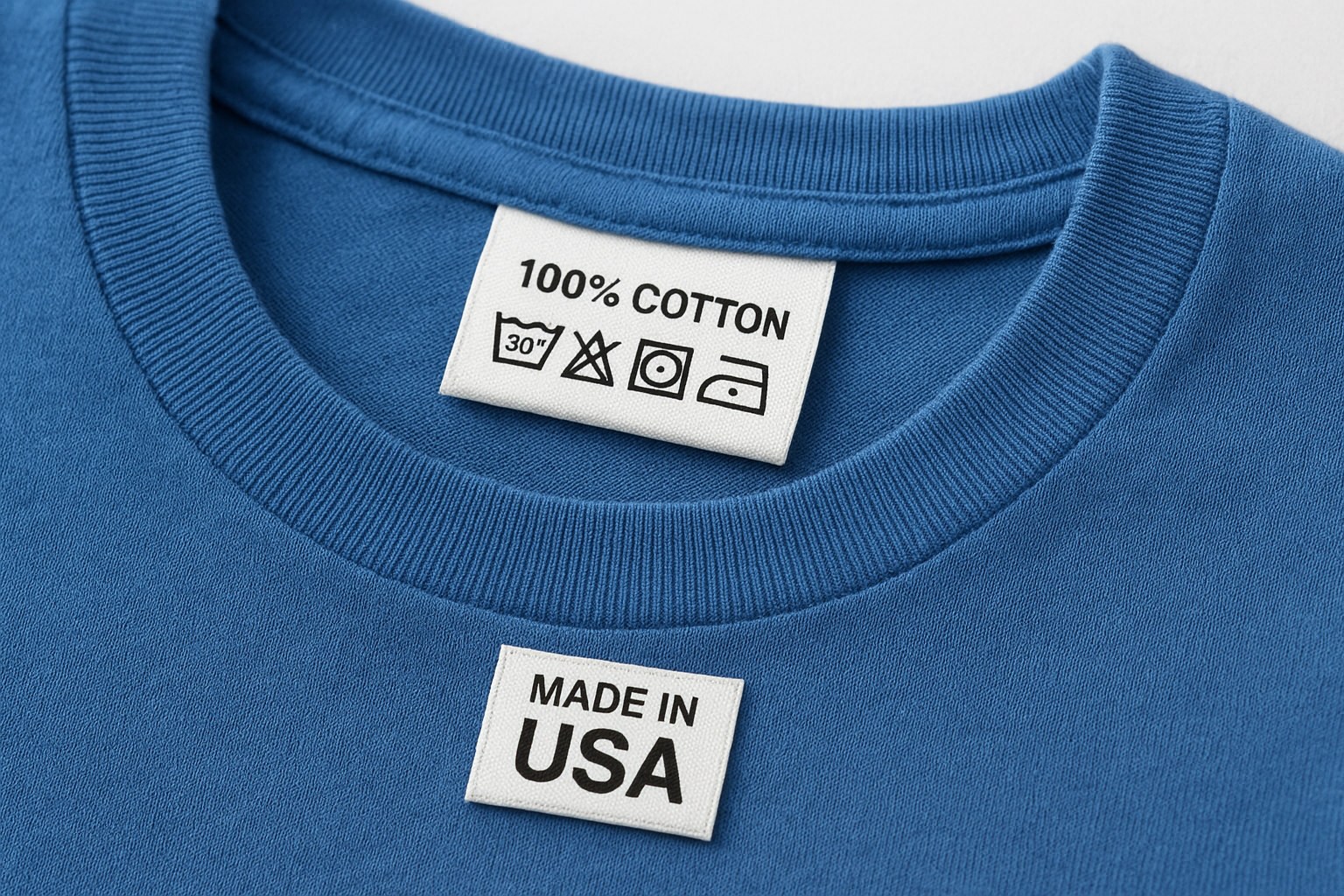
In the US, both care instructions and fiber content are legally required on every garment sold at retail.
Size labels
Size labels identify the garment's fit, whether that's a numeric size, a letter format like S/M/L, or both. They're usually placed near the brand label or sewn into the side seam, depending on your garment construction and preferred placement.
What information goes on each label
Understanding what are clothing labels means knowing exactly what each one needs to say. Each label type carries specific required information tied to its function, and missing any detail can create compliance problems or confuse customers at the point of purchase.
Brand label content
Your brand label typically carries your brand name or logo, and sometimes your country of manufacturing as well. Some brands also include a website or contact detail, though that's optional. Keep the design clean and on-brand, since this is the label customers see most.
Common elements on a brand label include:
- Brand name or logo
- Website or contact (optional)
- Country of origin (if not on a separate label)
Care and fiber content details
The care label must list washing, drying, bleaching, and ironing instructions using either written directions or standardized ASTM care symbols. Directly alongside that, you need to declare fiber content by percentage, for example "100% Cotton" or "60% Polyester, 40% Cotton." Both pieces of information are required by US law, and they typically appear on the same label to keep the garment interior tidy.
Combining care instructions and fiber content onto one label reduces bulk and gives the garment a cleaner interior finish.
Size and country of origin
Size information should appear clearly, whether you use numeric or letter-based sizing. Your label also needs to state the country of origin, for example "Made in Bangladesh" or "Made in Vietnam." Both fields are required for garments sold in the US market.
Legal requirements for clothing labels in the US
When brands ask what are clothing labels, legal compliance is often the part that surprises them most. In the US, the Federal Trade Commission (FTC) enforces specific labeling rules for garments sold at retail, and ignoring them puts your entire shipment at risk.
FTC rules you need to follow
The FTC requires three core pieces of information on every garment sold in the US: fiber content, care instructions, and country of origin. Fiber content must list each material by percentage in descending order. Care instructions must use either written directions or recognized ASTM care symbols. All three fields must appear in English, regardless of where the garment was manufactured.
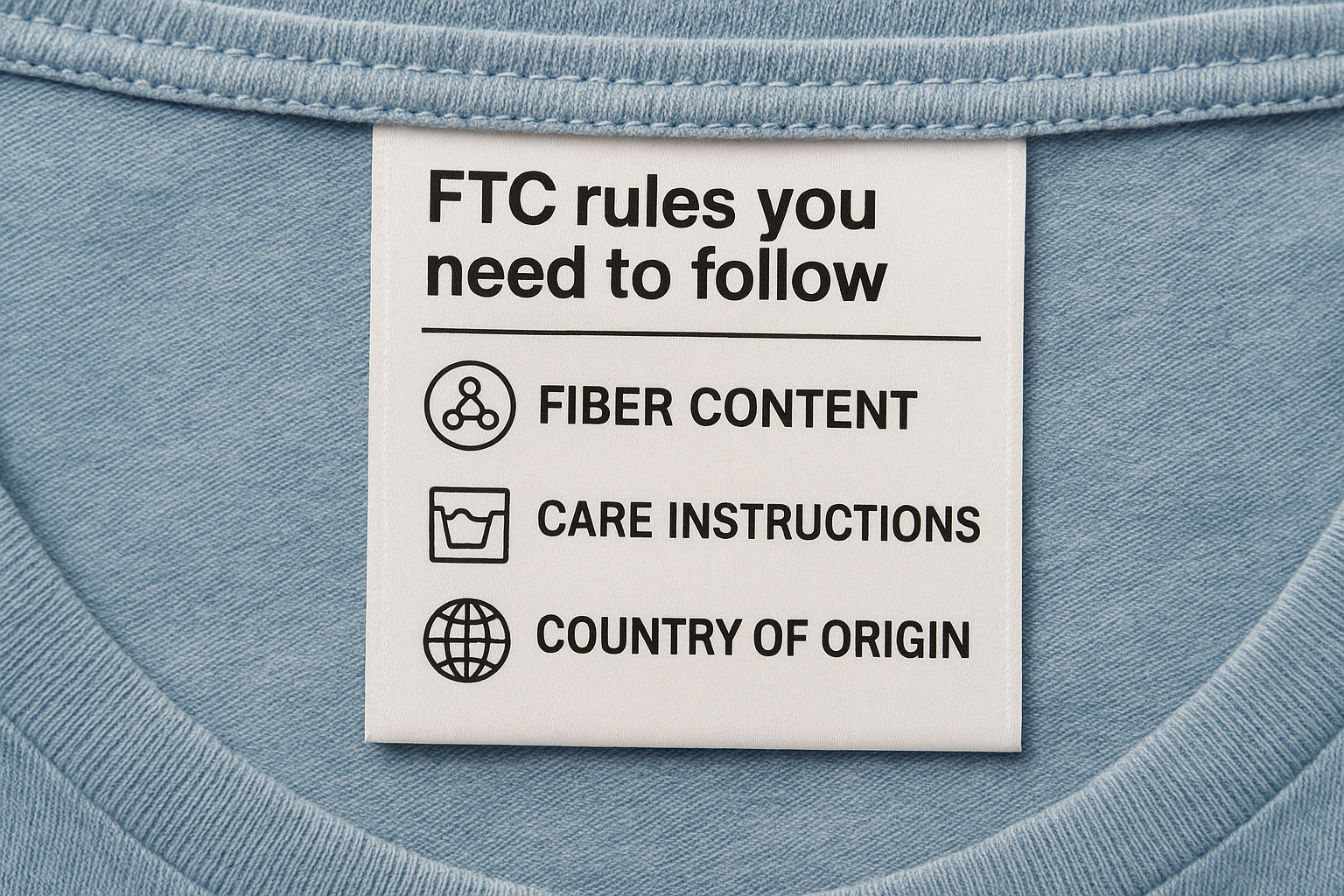
Skipping even one of these required fields can result in fines, product seizure, or forced relabeling before your goods reach the shelf.
Country of origin and RN numbers
Your garment must clearly state where it was manufactured, for example "Made in Vietnam" or "Made in Bangladesh." This is separate from where your brand is based. Additionally, if you sell under a business name rather than your personal name, the FTC requires you to display a registered number (RN) or a full business name on the label instead.
These requirements apply to most clothing categories, including tops, bottoms, outerwear, and activewear, so build them into your label specs before production starts.
How to spec labels for production
Once you understand what are clothing labels and what they must include, the next step is translating that knowledge into clear specs your factory can execute. Label specs are the formal instructions you send your manufacturer that define materials, dimensions, placement, and content for every label on your garment. Getting these details into writing before sampling prevents miscommunication and saves you from expensive revisions mid-production.
Define label type, size, and material
Start by specifying the format and material for each label: woven, printed, heat transfer, or sewn-in. Include the exact dimensions in centimeters or inches, and note whether the label folds or lays flat against the garment. Woven labels typically carry a minimum order quantity, so confirm that number with your label supplier before locking in your specs.
Providing a physical sample or a detailed technical sketch alongside your written specs significantly reduces the chance of misinterpretation during production.
Confirm placement and attachment method
Your spec sheet should state exactly where each label attaches on the garment and how it's applied, whether sewn in, heat pressed, or looped. Include a diagram or reference image if the placement is non-standard or specific to your design. Consolidating care instructions, fiber content, and size onto one interior label keeps the garment clean and reduces the number of attachment points your factory needs to manage.
Final takeaways
Understanding what are clothing labels shapes how you build a production-ready garment from the start. Every label on your product, whether it's your brand tag, care and fiber content label, or size marker, serves a specific purpose and carries legal weight in the US market. Skipping required information or leaving label specs vague creates problems that show up late in production, when they're hardest to fix.
The right approach is to define your label types, materials, content, and placement before you enter sampling. That way, your factory receives clear instructions the first time and you avoid costly revisions between rounds. Treating labels as part of your product design rather than an afterthought gives your garments a cleaner finish and a more professional presentation at retail.
If you're ready to move your collection from concept to production with dependable label development and manufacturing support, connect with the Manludini team to get started.
0 comments