
Every garment tells a story before someone even tries it on, and labels are where that story starts. The types of clothing labels you choose affect how customers perceive your brand, whether your products meet legal requirements, and how well your garments hold up after repeated washes and wear.
For brands moving from concept to production, labels are one of those details that seem small but carry real weight. A missing care label can cause compliance issues. A cheap brand label can undercut an otherwise well-made piece. At Manludini, we help fashion brands handle these decisions during development, from selecting the right label types to coordinating trims and private labeling before bulk production begins.
This article breaks down six main types of clothing labels, what each one does, and how to choose the right options for your garments. Whether you're building your first collection or refining an existing line, understanding your label options gives you more control over your finished product.
1. Brand labels
Brand labels are the most recognized of all the types of clothing labels in any garment. They carry your logo, brand name, and sometimes a tagline or founding year. What your brand label looks like sets the tone for your entire product before a customer reads anything else on the piece.
What it is and what it communicates
A brand label is the primary identifier on your garment. It tells the customer who made the piece and signals the quality and positioning of your brand at a glance. A well-executed brand label builds recognition and reinforces the value you want your product to communicate.
The look and feel of your brand label shapes the first impression a customer forms about your product's quality.
Common formats and placements
Brand labels come in several formats: woven labels sewn into the back neck, heat-transferred logos on the outside chest, or printed inside hem labels. Placement depends on the garment type and your brand identity. Neck labels remain the most common, but side-seam and hem placements are growing for streetwear and premium basics.
Best materials and finishes for brand labels
The most common materials are woven polyester, cotton twill, and satin. Woven labels hold detail well and resist fading through repeated washes. For a more premium feel, consider metallic thread, raised weaves, or soft-hand finishes that make the label feel as intentional as the garment itself.
Attachment methods and durability tradeoffs
Your main options are sewn-in, heat-pressed, and adhesive. Sewn-in labels last the life of the garment and suit most apparel types. Heat-pressed labels deliver a cleaner look with no visible stitching, but they can peel under repeated high-heat washing. Adhesive options degrade quickly in apparel use and rarely hold up past a few washes. For most brands, sewn-in woven labels offer the best long-term durability.
What to send your manufacturer to get it right
Send your manufacturer a high-resolution vector file of your logo, exact brand colors with Pantone codes, and your target label dimensions. If you have a reference label that matches the quality or feel you want, include it in your sample package. Clear instructions upfront cut down revision rounds and keep your sample timeline moving without unnecessary delays.
2. Care labels
Care labels sit alongside brand labels as one of the most important types of clothing labels in any garment. They tell the person wearing your product exactly how to wash, dry, and care for the piece, which protects both the garment and your brand's reputation.
What it is and why customers look for it
A care label is a functional label that gives your customer the information they need to keep your garment in good condition. Customers check care labels before washing, especially on new or higher-priced pieces, and a missing or unclear label leads to damaged garments and avoidable returns.
A clear care label reduces the chance that a customer ruins your product and blames your brand for it.
What to include on a care label
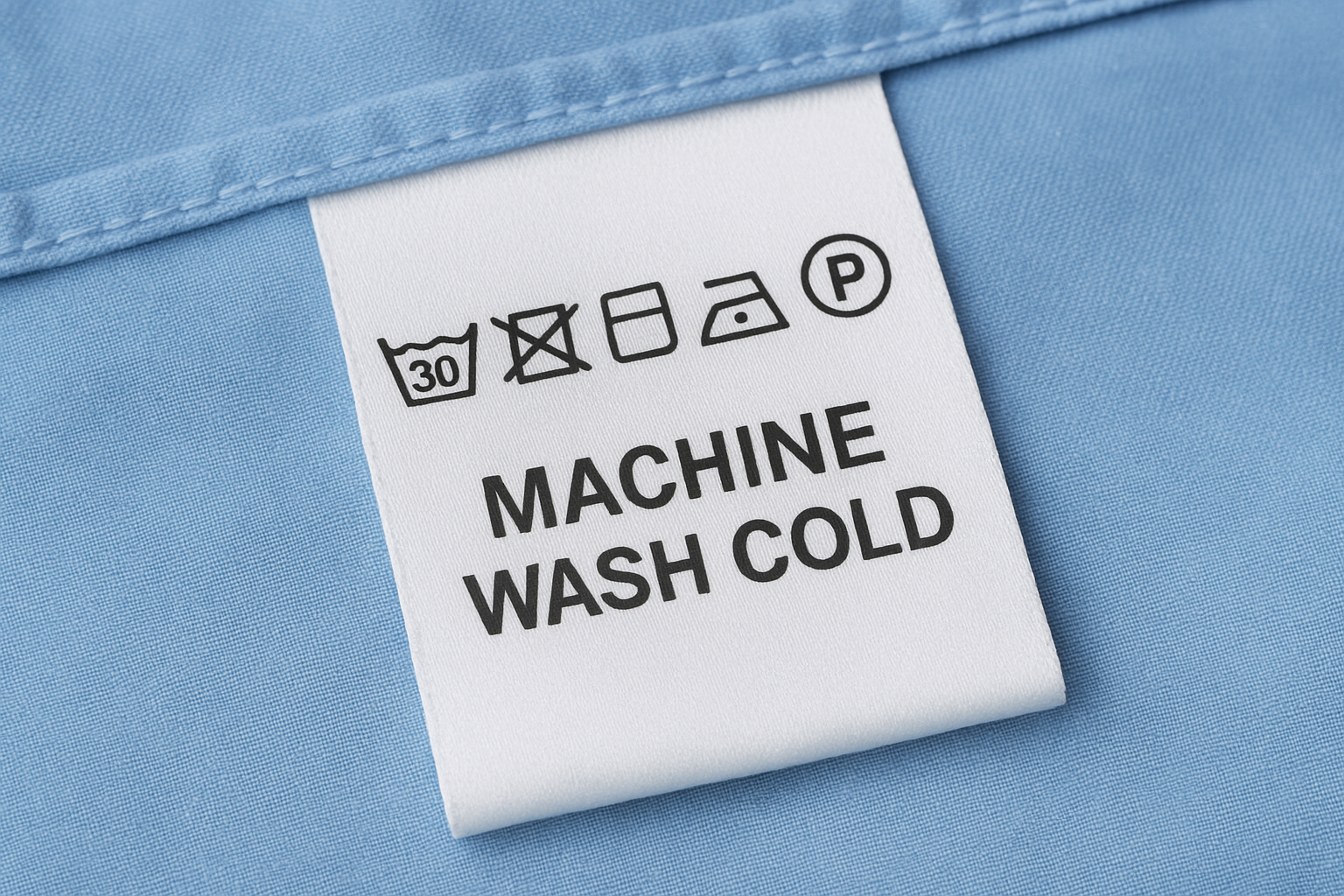
Your care label needs to cover washing instructions, drying method, ironing guidance, bleaching restrictions, and dry-cleaning notes. If your garment has special construction or finishes, call those out specifically. Keep the language short and direct so it stays readable at a small print size.
Care symbols and plain-language instructions
Most international markets expect ISO care symbols paired with written instructions. Symbols save space and work across languages, but plain-language text alongside them removes any guesswork for customers unfamiliar with the icons.
Materials, printing methods, and readability
Satin and taffeta are standard materials for care labels because they hold fine print well and stay readable after repeated washing. Direct-to-label printing keeps text sharp and legible at small sizes without adding thickness.
Placement and comfort considerations
Care labels typically go in the center back hem or left side seam. Both placements keep the label away from skin contact areas while remaining easy to find. Avoid the back neck for care labels since that placement already carries your brand label and adds unnecessary bulk.
3. Size labels
Size labels do one job: tell the customer whether the garment will fit. Despite their simplicity, they're one of the types of clothing labels that generate the most returns when handled poorly. A misread size label or an inconsistent sizing system costs you sales and customer trust.
What it is and how brands use it
A size label marks the specific size of a garment, typically sewn into the neck or side seam. Brands use size labels to guide customers at the point of purchase and to help retailers organize inventory by size run.
Size systems and consistency issues
Different markets use different systems. US, UK, EU, and Asian sizing don't always align, which creates confusion for overseas customers. Pick one primary size system and stay consistent across your entire collection to reduce avoidable returns.
Inconsistent sizing across your line forces customers to guess, and most won't guess twice before returning the item.
Common formats and placements
Size labels typically appear as woven or printed labels sewn into the back neck or left side seam. Some brands use a combined neck label that carries both the brand name and size on a single woven piece to cut down on label count.
Materials and production options
Woven polyester and satin are the most common choices because they're durable, wash-resistant, and hold text clearly at small sizes. Heat-transfer size marks are also available for brands that prefer a tagless feel on the inside of the garment.
How to avoid returns caused by sizing labels
Send your manufacturer a clear size spec sheet that maps your sizing to standard measurements in both centimeters and inches. Include fit notes for each size so there's no guessing during cutting and production.
4. Fiber content and origin labels
Fiber content and origin labels are among the most legally regulated types of clothing labels you'll produce. In the US, the Federal Trade Commission (FTC) requires fiber content disclosure on most textile products sold to consumers, which means these labels aren't optional.
What it is and when it becomes a legal need
This label tells your customer what the garment is made of and where it was manufactured. If you sell into the US market without one, you risk compliance issues that can delay your launch or trigger product recalls.
Treating this label as a legal requirement from the start saves you from costly corrections after production.
Typical required fields for apparel labels
Your label must include the following:
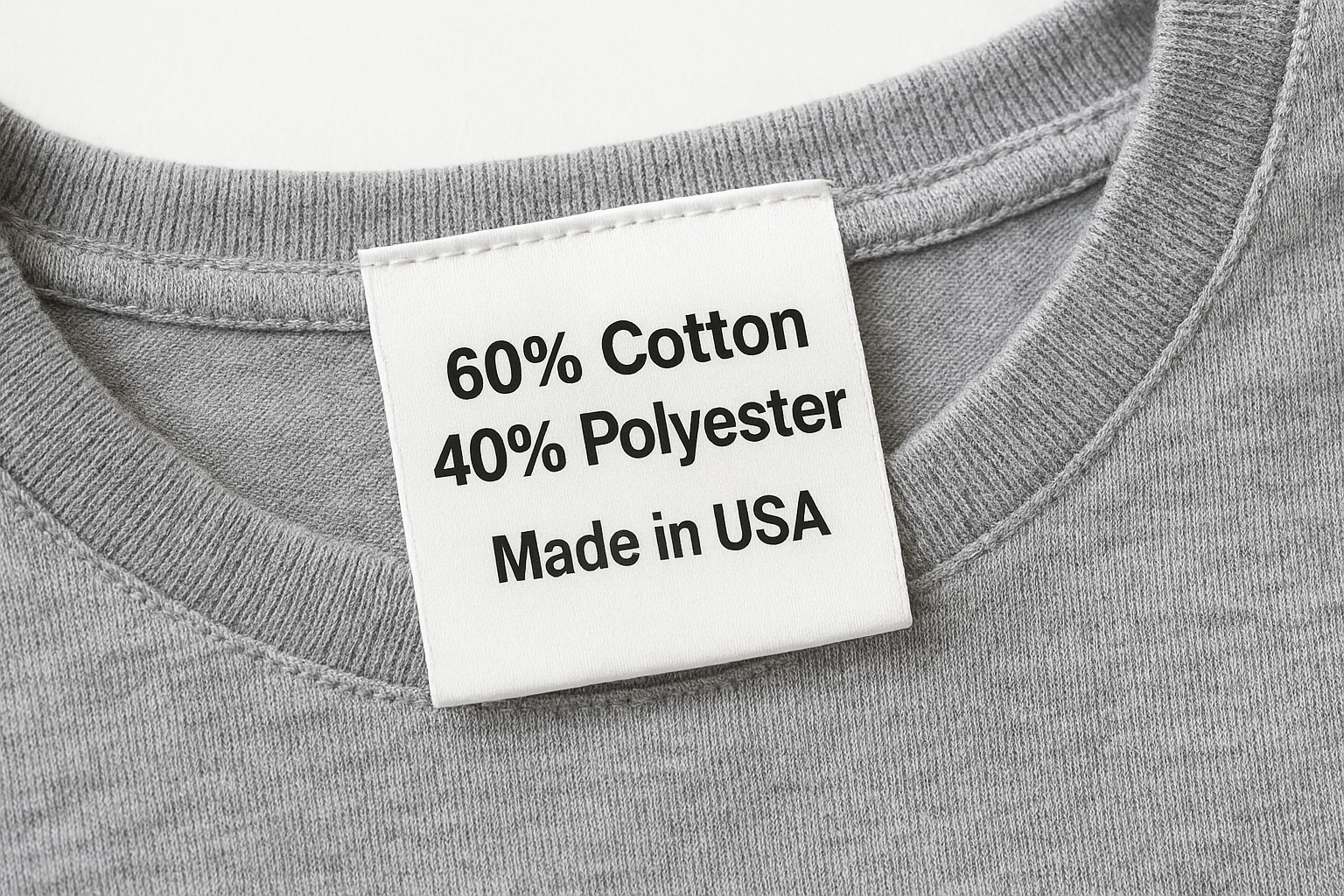
- Fiber content percentages listed from highest to lowest
- Country of origin
- Manufacturer or importer name, or RN number for US importers
- A reference to care instructions if not combined on the same label
How to format fiber percentages clearly
Use the full fiber name rather than abbreviations, and list each fiber in descending order. "60% Cotton, 40% Polyester" meets FTC formatting standards and leaves no room for misreading.
Country of origin and manufacturer details
Your country of origin must reflect where the garment was substantially transformed, not just where it shipped from. Include your importer name or RN number to stay compliant with US labeling rules.
Where to place it and how to keep it legible
Place this label in the center back hem or left side seam, often combined with the care label. Print on satin or taffeta with durable ink so the text holds up after repeated washing.
5. Hang tags
Hang tags are one of the types of clothing labels that live outside the garment rather than inside it. They attach to the outside of your product before it reaches a customer, and they carry brand and product information in a format customers see before the garment is ever tried on.
What it is and what it sells
A hang tag is a detachable card or label fastened to your garment with a string, pin, or barb. It communicates your brand identity and product story at the point of sale, making it one of the most visible tools in your packaging.
Your hang tag is often the first thing a retail customer picks up, so what it says and how it looks matters as much as the garment.
What to include on a hang tag
Your hang tag should carry your brand name and logo, price if applicable, a short product description, and care or fabric highlights. Keep the copy tight so the tag stays readable at a small format.
Materials, finishes, and print methods
Kraft paper, coated cardstock, and textured uncoated stock are the most common choices. Finishes like soft-touch laminate or foil stamping add a premium feel without significantly raising your unit cost.
How to attach tags and choose fasteners
Plastic barbs and cotton twine are the two standard fasteners. Barbs attach quickly during packing and suit most garment types, while twine gives a handcrafted look that fits premium or sustainable brands.
Barcode and retail-ready considerations
If your garments will sell through retail stores, your hang tag needs a scannable barcode or QR code with your SKU and pricing details. Confirm barcode format requirements with your retailer before finalizing the design to avoid rejection at intake.
6. Decorative and specialty labels
Decorative and specialty labels are the types of clothing labels that go beyond function and become a design detail in their own right. They add texture, dimension, and character to a garment in ways that standard woven or printed labels rarely achieve.
What it is and when it makes sense
A specialty label is any label designed to stand out visually or tactilely rather than simply communicate text. It makes sense when your brand identity calls for more than a flat woven label, especially on premium, streetwear, or heritage-style products where every detail contributes to the overall presentation.
Specialty labels work best when they reinforce your brand story rather than just repeat your logo in a different format.
Common types like patches, hem tags, and tagless prints
Your options here include embroidered patches, woven hem tags, printed inner neck labels, and tagless heat transfers. Each format serves a different purpose, from decorative exterior patches on outerwear to clean tagless prints inside performance pieces.
Material choices like woven, rubber, leather, and TPU
Woven fabric, genuine or synthetic leather, rubber, and TPU are the most common materials. Leather and rubber labels signal premium quality, while TPU suits technical and activewear lines where flexibility and water resistance matter.
Attachment methods like sew-on, heat press, and rivets
Sew-on and heat-press cover most specialty label applications. Rivets work well for denim and heavy canvas pieces where a metal fastener adds to the overall aesthetic.
Where specialty labels work best on garments
Chest, sleeve, back yoke, and hem placements all work well for specialty labels. Match the placement to the label's size and the garment's construction so it sits flat and stays secure through normal wear and washing.
Next steps for your label plan
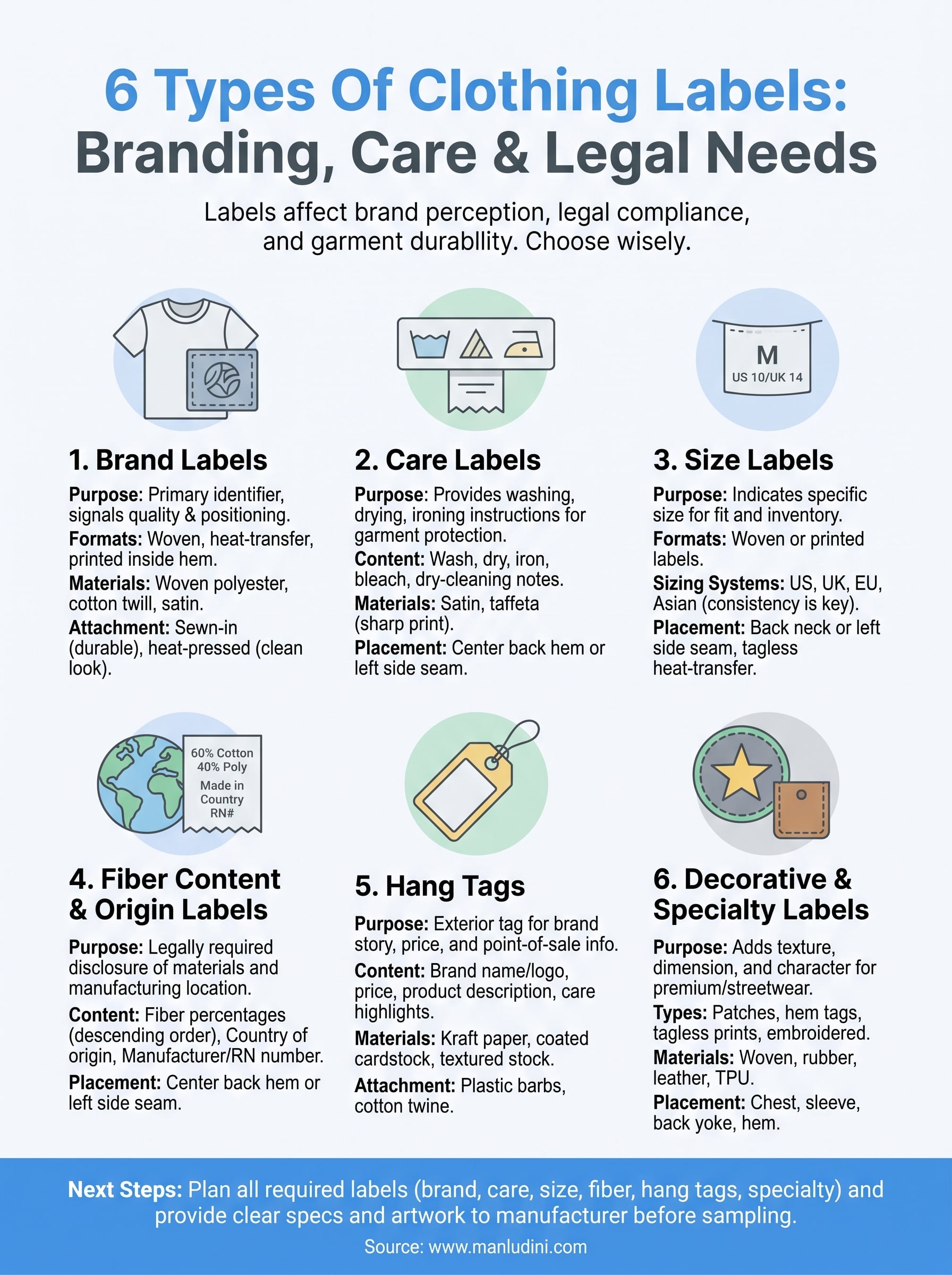
Now that you know the six main types of clothing labels, the next step is making decisions specific to your garments, your market, and your brand positioning. Start by listing every label your product needs, including brand, care, size, fiber content, hang tags, and any specialty details, so nothing gets missed before your sample goes into development.
Once your label list is complete, gather your artwork files, Pantone references, size specs, and any compliance requirements for the markets you sell into. Clear documentation handed to your manufacturer before sampling starts reduces back-and-forth and keeps your timeline intact. Labels that get treated as an afterthought tend to delay production and add unnecessary cost.
If you're ready to move forward with sample development or bulk production, the team at Manludini can help you coordinate labels, trims, and packaging from the start of your project.
0 comments