
Every garment tells a story, and custom brand labels for clothing are where that story starts. They're the first thing a customer notices when they pick up a piece, check the fit, or flip through a rack. A well-made label doesn't just display your brand name, it signals quality, builds recognition, and sets your line apart from generic alternatives.
But getting labels right involves more than picking a font and a color. You need to think about material, size, placement, printing method, and how each choice affects cost at scale. Whether you're launching your first collection or refreshing an existing line, the details matter, and mistakes here can delay production or weaken how your brand comes across.
At Manludini, we handle custom label development as part of our full production support, from woven and printed labels to hangtags and packaging. We work directly with brands to coordinate trims alongside sampling and bulk manufacturing, so everything arrives consistent and ready to ship.
This guide breaks down how to design, specify, and order custom clothing labels, covering label types, material options, design tips, and what to expect during production.
What custom brand labels for clothing include
When brands talk about custom brand labels for clothing, they usually mean more than just the neck label. A full label package covers multiple touch points across a garment, and each one plays a specific role in communicating your brand identity, product information, and compliance requirements. Understanding what falls under this category helps you plan your label order with more accuracy and avoid gaps that slow down your production timeline.
Main identity labels
The identity labels are the ones most customers notice first. Your main brand label typically sits at the center back neck, at the waistband, or at the chest, depending on the garment type. This label carries your brand name, logo, and sometimes a tagline or collection name, and it sets the tone for how your garment is perceived, whether that reads as premium, hand-crafted, or mass-produced.
The material and finish of your main label often communicates more about your brand than the logo itself.
These labels come in several formats. Woven labels are stitched into the fabric and offer a structured, permanent look with fine detail. Printed labels use heat transfer or screen printing directly onto a fabric strip. Foldover labels fold at the top and get sewn along both sides into a seam, which gives a clean finish without exposed edges. Each option carries different cost points, minimum order quantities, and durability profiles, so the right choice depends on your garment construction and your brand positioning.
Hangtags, packaging labels, and trim accessories
Hangtags attach to the garment before sale and typically display your brand logo, price point, size, or a short collection story. They give you flexibility to communicate information that does not need to be permanent, and they are easy to update between seasons without touching your sewn labels. Buyers at retail often make a purchase decision while holding the hangtag, so its paper weight, print quality, and finishing all carry commercial weight.
Your packaging labels round out the label package. These include stickers, poly bag labels, tissue paper stamps, and box inserts. Brands that keep their packaging labels consistent with their sewn labels create a more coherent experience from the shelf to the unboxing moment. Buyers notice when that consistency is there, and they also notice when it is not.
Some garments also call for specialty branding elements like woven patches, rubber labels, or embroidered badges. These work well for outerwear, denim, athletic wear, and accessories where a sewn-in fabric label would not carry the same visual weight. Specialty labels cost more per unit but give you placement and texture that standard printed labels cannot replicate.
Care, size, and compliance labels
Care labels are not optional in most markets. In the United States, the Federal Trade Commission (FTC) requires garments sold domestically to carry permanent care instructions that include fiber content, country of origin, and manufacturer identification. These labels must stay readable through the full life of the garment, which means the material and printing method both matter.
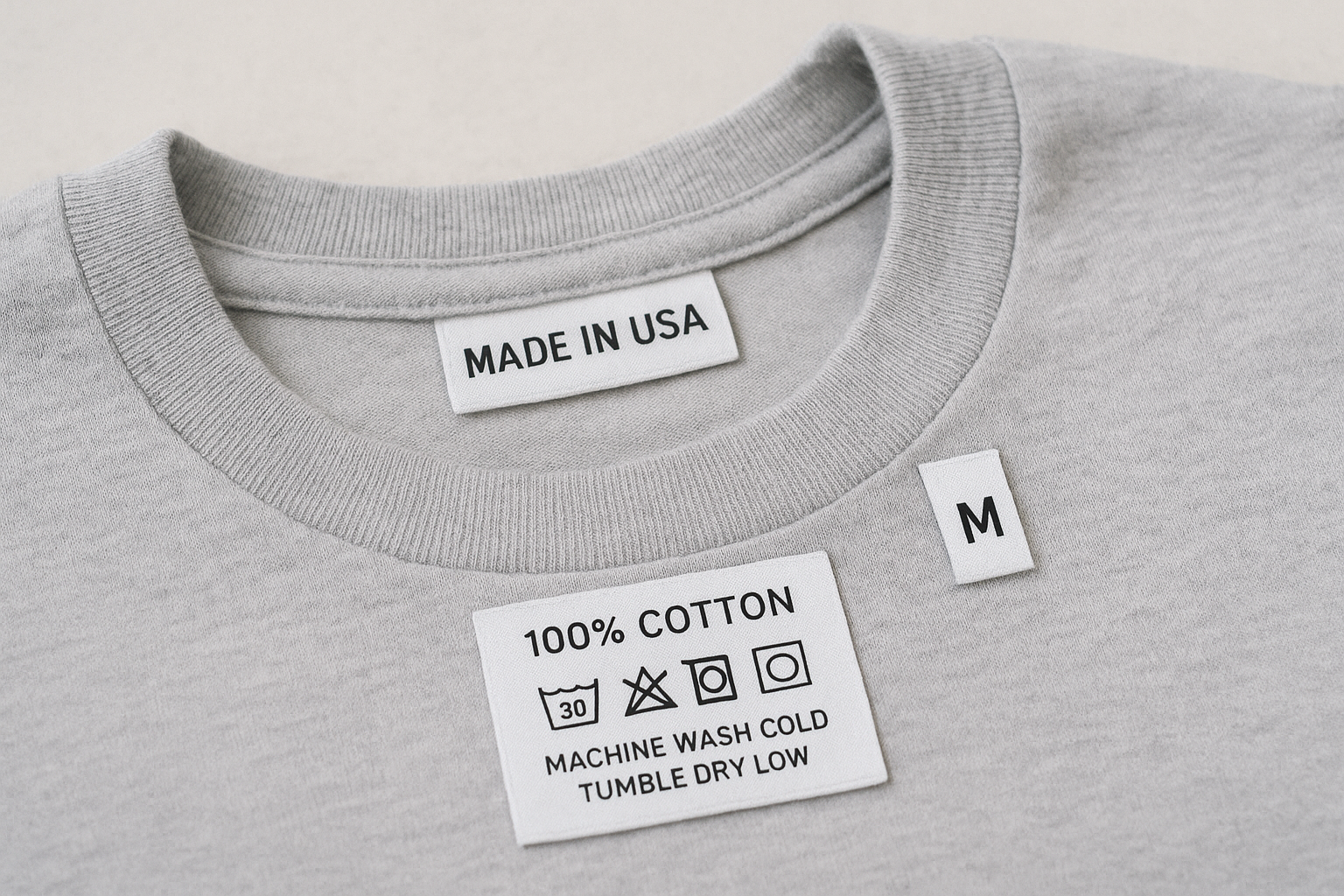
Size labels are either combined with care labels or placed separately at the side seam, depending on the garment and your preference. Your sizing format needs to match your target market. A label printed with "M" reads differently than one showing a numeric measurement or EU sizing, and getting this wrong increases customer confusion and return rates.
Many brands consolidate care and size information into a single printed strip to reduce the number of labels inside the garment, which also makes the wearing experience cleaner for the customer. If you are producing across multiple markets, plan for label variations early, since compliance requirements differ by country and changing labels mid-production creates delays.
Why brand labels matter for apparel brands
Labels do more work than most brands give them credit for. When a customer picks up a garment, the label is often the first thing they examine to gauge quality before they even check the construction or the fabric. A label that looks cheap, feels rough against the skin, or carries blurry print creates doubt immediately, and that doubt is hard to recover from once it is formed.
Labels shape how buyers perceive your product
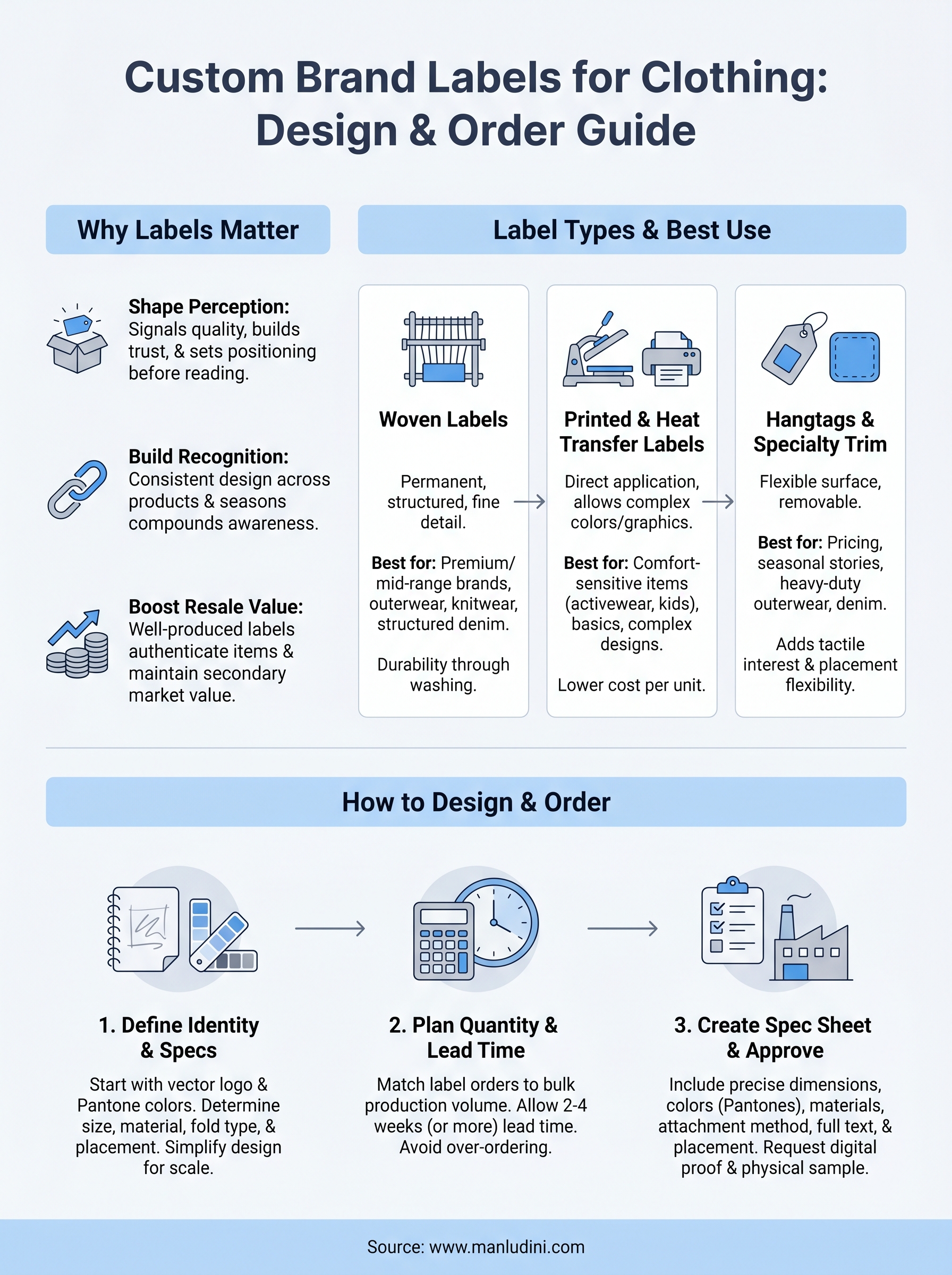
Your label signals positioning before the customer reads a single word. A finely woven label with clean edges communicates precision and attention to detail. A flimsy iron-on label with uneven printing communicates the opposite, even if the garment itself is well-made. Retailers and wholesale buyers evaluate labels during the review process, and weak label quality can result in a rejected order or a lower price offer regardless of how strong the product is.
Investing in quality labels early costs less than re-labeling a completed bulk order because a retail buyer rejected the trim package.
This also applies to direct-to-consumer brands selling through e-commerce. When a customer unboxes your product, the label is part of what confirms the purchase was worth making. Inconsistent or low-quality custom brand labels for clothing create a disconnect between what you charged and what the customer received, which raises return rates and reduces repeat purchases.
Labels build brand recognition across every touchpoint
Recognition compounds over time, but only if your label design stays consistent across seasons and product categories. When your neck label, hangtag, and packaging all carry the same visual language, a customer who receives one of your garments as a gift can identify your brand before they see a website or a storefront. That kind of recognition is hard to build, and switching label formats or styles frequently disrupts it.
Strong labels also support resale value and authenticity signals. As resale markets grow, buyers on secondary platforms look for consistent, well-produced label details to confirm authenticity. Brands with clean, recognizable label systems hold stronger resale positioning than those with inconsistent or poorly executed trims. This matters even for emerging brands, because building that identity early costs less than trying to correct it after you have scaled.
Label types and when to use each one
Not every label works for every garment. Choosing the right label type for each application depends on your garment construction, price point, and design complexity. Matching the label type to the context prevents costly remakes and keeps your finished product looking intentional.
Woven labels
Woven labels are produced on a loom, which means the design is built directly into the fabric threads rather than printed on top. This gives them a permanent, structured look that holds up through repeated washing without fading or peeling. Woven labels work best for premium or mid-range brands where durability and texture matter, such as tailored outerwear, knitwear, or structured denim. They typically require a higher minimum order quantity than printed options, so plan your volume accordingly before committing.
Woven labels communicate quality through texture alone, before the customer reads a single word on them.
Printed and heat transfer labels
Printed labels apply your brand design directly onto a fabric strip or onto the garment itself, using screen printing, digital printing, or heat transfer methods. They cost less per unit than woven labels and allow for more color detail, which makes them a practical choice for brands that need complex graphics or photographic elements. Heat transfer labels, sometimes called tagless labels, bond directly to the inside of the garment fabric, eliminating the scratchy feel that some woven labels produce. Use printed or heat transfer labels when your collection targets comfort-sensitive categories like activewear, children's clothing, or basics.
Hangtags and specialty trim labels
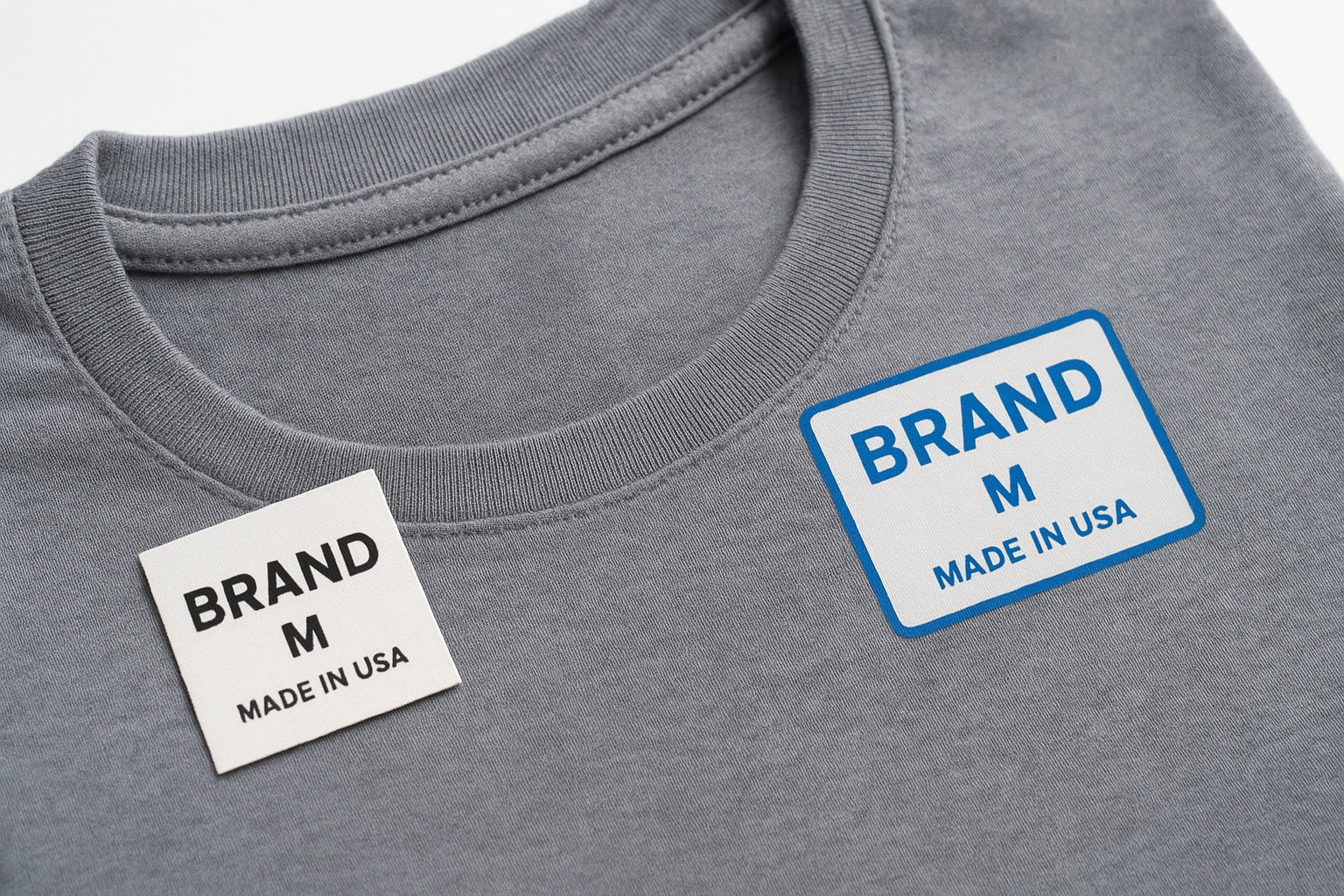
Hangtags give you a flexible surface to communicate information that changes seasonally, such as pricing, collection names, and product stories, without touching your sewn labels. Choose a card stock weight and finish that matches your brand positioning, since a thin, flimsy hangtag signals low investment even when the garment itself is strong. Specialty labels like rubber patches, embossed leather tabs, and woven badges work best for categories where a standard sewn label would get lost visually, such as heavy-duty outerwear, denim back pockets, or structured bags. These custom brand labels for clothing add dimension and tactile interest that printed alternatives cannot match, but they carry a higher unit cost and longer lead time, so build that into your sampling schedule from the start.
How to design and order labels that work
Designing labels that hold up in production starts with decisions you make before you open any design software. Most brands lose time by choosing a label format first and then trying to fit their identity into it. The better approach is to define what your brand needs to communicate and then select the format, material, and printing method that delivers that message at your target price point.
Start with your brand identity
Your logo, color palette, and typeface are the foundation of every label decision. Before you brief a manufacturer or a designer, confirm that you have a high-resolution version of your logo in vector format, since rasterized files lose detail when scaled to label dimensions. Woven labels require your design to be simplified to a thread count the loom can replicate accurately, which means photographic gradients and thin hairline strokes rarely survive the conversion process intact.
Sending a low-resolution logo to your label supplier is one of the fastest ways to end up with a label that looks nothing like your brand.
Think about how your label will read at its actual finished size. Most neck labels measure between 1 and 2 inches wide, which leaves very little space for complex artwork. Test your design at scale before you finalize anything. If your brand name disappears or your logo loses clarity at that size, simplify the artwork now rather than after you receive a sample that you need to reject.
Plan your order quantities and lead times
Ordering custom brand labels for clothing without a clear quantity plan leads to either over-ordering, which ties up cash, or under-ordering, which stalls your bulk production run. Minimum order quantities for woven labels typically start at 100 to 500 units, while printed and heat transfer labels often allow smaller runs. Match your label order to your confirmed production volume so you are not holding excess inventory when you update your logo or shift colorways next season.
Lead times for labels run 2 to 4 weeks for standard production and longer when your design calls for specialty materials or multi-color weaving. Place your label order at the same time you confirm your sampling schedule so labels and trims arrive at the factory together. Delays in trim delivery are one of the most common reasons bulk production ships late, and a straightforward ordering timeline prevents most of those situations before they start.
How to spec labels for your manufacturer
Sending a clear label specification to your manufacturer saves you from sample rejections, miscommunication, and wasted production time. When you spec custom brand labels for clothing, you are giving your factory a precise reference document that removes guesswork from every step of production. A weak spec sheet creates room for interpretation, and the factory will fill that gap with their own judgment, which rarely matches your brand intent.
What to include in your label spec sheet
Your label spec sheet needs to cover every measurable detail your factory requires to produce an accurate sample on the first attempt. A complete spec document reduces back-and-forth emails and shortens the approval cycle before bulk production begins.
Include the following in your spec sheet:
- Finished dimensions: width and height in inches or centimeters, with fold type noted (foldover, straight-cut, or mitered)
- Material: fabric type for woven labels or substrate type for printed labels, including weight if relevant
- Color references: Pantone codes for all colors used, not just the logo but also the background fabric
- Attachment method: specify whether the label is sewn in, heat-applied, or glued, and note which edges are stitched
- Placement and position: indicate exactly where the label sits on the garment, with a measurement from the nearest seam
- Text content: full copy for care labels, size indicators, and compliance information, confirmed against your target market requirements
- File format: provide vector artwork files, ideally in .AI or .EPS format, not JPG or PNG
A spec sheet without Pantone references almost always results in a color match that looks correct on screen but reads differently on the finished label.
How to communicate clearly with your factory
Written specs work best when you pair them with physical reference samples or annotated photos of existing labels you approve of. Your factory team will compare the spec document against your reference and flag conflicts before they start production, which is exactly what you want to happen at that stage.
Always confirm your label specifications in writing and ask your factory to send a digital proof or a labeled diagram before they produce the physical sample. This step catches sizing errors and placement mistakes early, when fixing them costs nothing. Keep your approved spec sheet on file for every style, so future reorders match the original without requiring a new round of samples.
Final checklist before you place an order
Before you confirm your label order, run through these steps to catch any gaps that could delay production or require costly remakes. Confirm you have a vector logo file ready and that your Pantone color references match your actual brand colors, not a screen approximation. Verify your care and compliance text against the requirements for your target market, since missing FTC-required information means relabeling a completed order. Check that your placement instructions include measurements from the nearest seam, and confirm your label quantities match your confirmed bulk production volume.
Getting your custom brand labels for clothing right the first time comes down to clear specs, accurate files, and a manufacturing partner who handles trims alongside your full production run. If you want label development built into your sampling and bulk manufacturing process from the start, work with Manludini to coordinate your full trim package alongside production.
0 comments