
Figuring out how to find a clothing manufacturer is one of the first real hurdles you'll face when building a fashion brand. You've got designs, maybe a tech pack or two, and a vision for your collection, but turning that into actual garments means finding the right production partner. And that search? It can get overwhelming fast when you don't know where to start or what to look for.
The truth is, most brands don't struggle because good factories don't exist. They struggle because the vetting process is unclear, the terminology is confusing, and there's no obvious path from "I need a manufacturer" to "I'm shipping orders." Whether you're sourcing domestically or overseas, the steps you take early on, how you research, how you communicate your needs, and how you evaluate a factory's capabilities, will shape your entire production experience.
At Manludini, we work directly with fashion brands on sample development, bulk production, and everything in between, from fabric sourcing to private labeling to quality control. We've seen firsthand what makes a manufacturer-brand relationship work and where it breaks down. That experience is exactly what shaped this guide. Below, we'll walk you through a practical, step-by-step process for finding, evaluating, and partnering with a clothing manufacturer that actually fits your brand's needs, budget, and stage of growth.
What you need before you contact factories
Before you figure out how to find a clothing manufacturer, you need to figure out what you're actually bringing to the table. Factories evaluate brands just as much as brands evaluate factories. If you contact a manufacturer with vague requests, no specs, and no clear sense of your order quantities, you'll get slow responses, rough quotes, and a weaker position from the start. Preparation signals professionalism, and it directly affects how seriously a factory takes your inquiry.
Know your product details
Every factory conversation starts with the product. You need to be specific about what you're making: the garment type, construction details, fabric preferences, and any special finishes like embroidery, printing, or washing treatments. The more clearly you can describe your product, the faster a factory can assess whether it's a fit for their production line.
If you don't have a full tech pack yet, at minimum you should have: a clear description of the garment, reference images or a physical sample, a rough fabric specification (like "100% cotton jersey, 180 GSM"), and a list of trims and labels you need. This baseline keeps your first conversation productive instead of going in circles.
The more clearly you define your product upfront, the fewer rounds of back-and-forth you'll need before sampling even begins.
Define your order volume and budget
Factories structure their pricing around minimum order quantities (MOQs), which vary significantly depending on where they're based and what they specialize in. Domestic manufacturers often accept lower MOQs but charge more per unit. Overseas factories, particularly in Asia, typically offer lower per-unit costs but require higher minimum quantities, sometimes 300 to 500 pieces per style or more.
Know your realistic numbers before you reach out. Think through how many units per style you can commit to, what you can spend on samples (usually $50 to $300+ per piece depending on complexity), and what your target cost per garment is for bulk. You don't need to share every figure upfront, but having these numbers in your head keeps you from wasting time on factories that don't fit your scale.
Put together a factory brief
A factory brief is a short document that gives a manufacturer everything they need to respond to your inquiry quickly. You don't need a finished tech pack to write one, but you do need to organize your information clearly. Here's a simple template you can use:
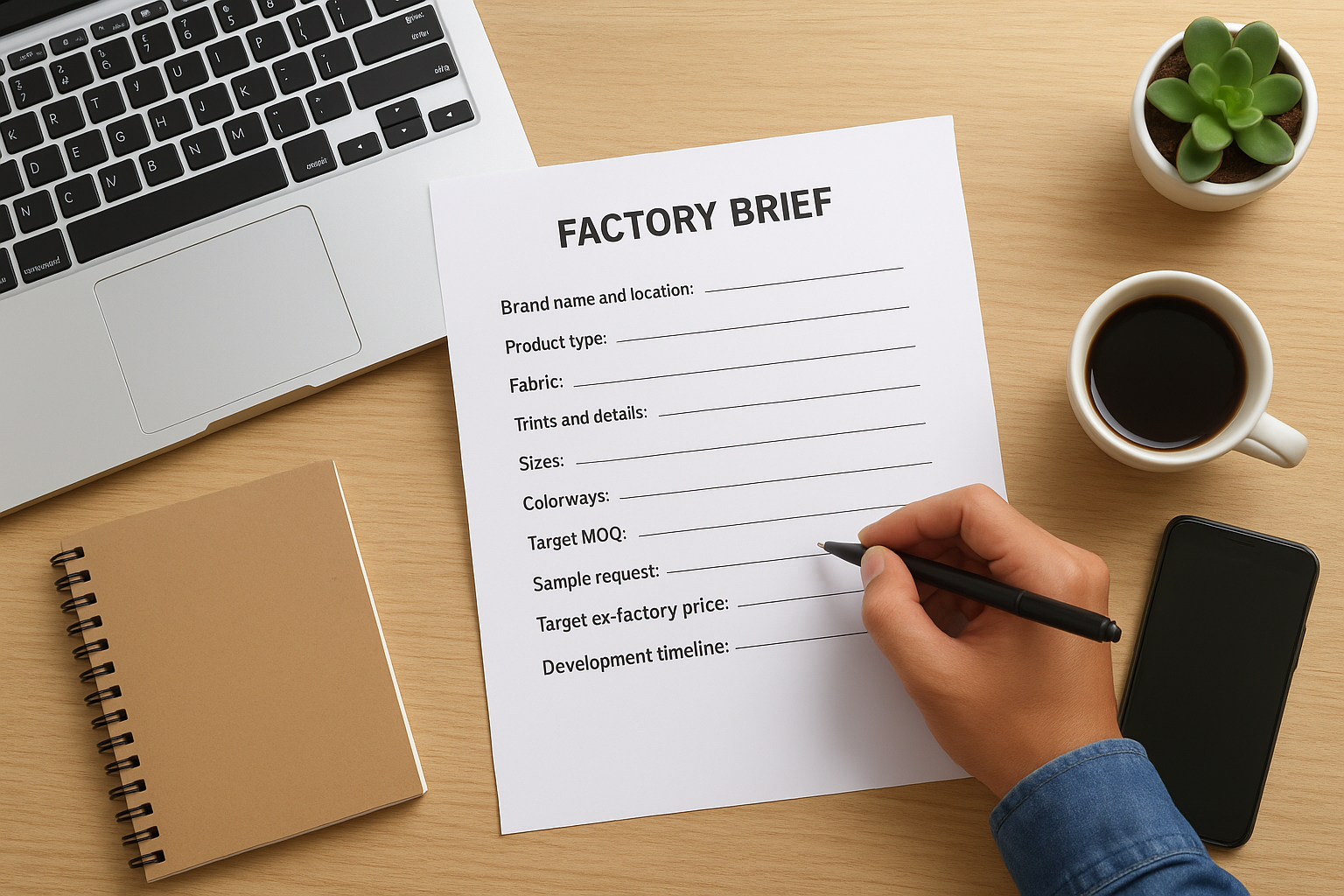
Factory Brief Template
- Brand name and location: [Your brand, country]
- Product type: [e.g., women's woven blazers]
- Fabric: [e.g., 70% polyester, 30% viscose, woven twill]
- Trims and details: [e.g., 4-hole buttons, welt pockets, half-lining]
- Sizes: [e.g., XS to XL]
- Colorways: [e.g., 2 colors per style]
- Target MOQ: [e.g., 200 pieces per color]
- Sample request: [Yes or No, with your timeline]
- Target ex-factory price: [e.g., $18 to $22 USD per piece]
- Development timeline: [e.g., samples needed by August 2026]
Sending a brief like this with your first message cuts response time significantly and positions you as a serious buyer. Factories can immediately tell whether your product, volume, and price expectations are a match for their capabilities, which saves everyone time and moves the conversation forward faster.
Step 1. Build a shortlist of manufacturers
Once your prep work is done, you can start the actual search. Building a shortlist means gathering 8 to 12 potential manufacturers before you contact anyone, so you're not putting all your weight on one factory from the start. Having options also gives you negotiating leverage later when it comes to pricing and lead times.
Where to look for manufacturers
Knowing how to find a clothing manufacturer starts with knowing where to look. The most common starting points are sourcing platforms, trade directories, and trade shows. Each channel has different trade-offs in terms of verification, communication speed, and the type of factories you'll reach.
Here's a breakdown of the main sourcing channels and what to expect from each:
| Source | Best for | What to watch out for |
|---|---|---|
| Alibaba / Global Sources | Overseas factories, large volume | Verify business licenses and audit reports |
| Maker's Row | US-based manufacturers | Higher MOQs, premium pricing |
| Trade shows (e.g., Magic Las Vegas) | Meeting factories face to face | Requires travel investment |
| Referrals from other brands | Pre-vetted contacts | Limited to your network |
| Direct outreach via factory websites | Specific factory types | Time-intensive, requires research |
When you use platforms like Alibaba, filter by verified suppliers and look for factories with trade assurance enabled. That doesn't guarantee quality, but it reduces the risk of working with a middleman pretending to be a factory.
Referrals from other brands in your niche are often the most reliable shortlist-building method because someone has already done the vetting work for you.
How to narrow your list down
Your goal at this stage is not to find the perfect factory, it's to identify realistic candidates worth contacting. Scan each factory's website or profile and look for three things: whether they specialize in your garment type, what their stated MOQ range is, and whether they've worked with brands at your scale before. A jacket factory and a knitwear factory are not interchangeable, even if both produce clothing.
Cut any factory that doesn't produce your specific garment category or lists MOQs dramatically above your planned order size. You should end up with 8 to 12 manufacturers that are plausibly a fit before you send a single message.
Step 2. Vet factories like a production manager
Once you've built your shortlist, the next step is separating capable factories from the ones that will cost you time, money, and production delays. Most brands make the mistake of judging factories too quickly on price alone or skipping the vetting process entirely. A production manager approach means treating this like a job interview where you're doing the hiring, not hoping to be accepted.
What to ask in your first message
Your first outreach to a factory should do two things at once: introduce your project clearly and gather the information you need to evaluate them. Don't send a one-liner asking for a price quote. Instead, send your factory brief alongside a short list of qualifying questions.
Here are the key questions to include in that first contact:
- What garment categories do you specialize in?
- What is your standard MOQ per style and per color?
- What is your typical sample lead time, and what is the sample cost?
- Can you share photos or references from similar products you've produced?
- Do you handle fabric sourcing, or does the client supply materials?
- What is your bulk production lead time for an order of [your expected quantity]?
- What quality control steps do you have in place before shipment?
The answers tell you a lot, not just in content but in how quickly and thoroughly the factory responds. A factory that answers in detail within 48 hours is already showing you something real about how they operate.
How a factory communicates during vetting is a direct preview of how they'll communicate during production.
Red flags to watch for
Part of knowing how to find a clothing manufacturer is knowing when to walk away. Slow or vague responses, pressure to commit before sampling, and reluctance to share references or photos of previous work are all warning signs. A legitimate factory wants to build trust, not rush you into a deposit.
Watch out specifically for factories that cannot confirm their MOQ in writing, switch contacts frequently, or quote prices that sit far below the market average. Pricing that seems unrealistically low almost always means a compromise somewhere, whether in fabric quality, construction standards, or labor conditions.
Step 3. Request samples and lock specs
Sampling is where your production relationship becomes real. This stage protects you from committing bulk order money to a factory that can't execute your design correctly. No matter how professional a factory looks on paper, a physical sample is the only honest test of their capabilities. Knowing how to find a clothing manufacturer is only half the job; knowing how to run a proper sample round is what keeps your production on track.
How to place a sample order correctly
When you request a sample, be as specific as possible in writing. Send your tech pack, reference photos, fabric swatches if you have them, and a clear notes document that covers fit points, stitching requirements, and any finishing details. The more complete your brief, the less room there is for the factory to interpret your design in the wrong direction.
Here is a simple sample request checklist you can send alongside your brief:
- Tech pack or detailed sketch with measurements in the size you want sampled
- Fabric specification: fiber content, weight, and construction (e.g., 180 GSM cotton jersey)
- Trim list: buttons, zippers, labels, threads, and hardware
- Stitch type and seam allowance requirements
- Color references: Pantone codes or physical swatches
- Fit notes: where the garment should sit, any ease preferences
- Label and packaging requirements if applicable
A complete sample request reduces revision rounds, which directly lowers your sampling cost and shortens your timeline.
What to review when your sample arrives
When the sample lands in your hands, evaluate it against your spec sheet point by point, not just by feel or visual impression. Check measurements against your tech pack across every size point. Look at seam construction, stitching consistency, and how the trims sit. Note every deviation in writing with photos, because that document becomes your revision brief for the next round.
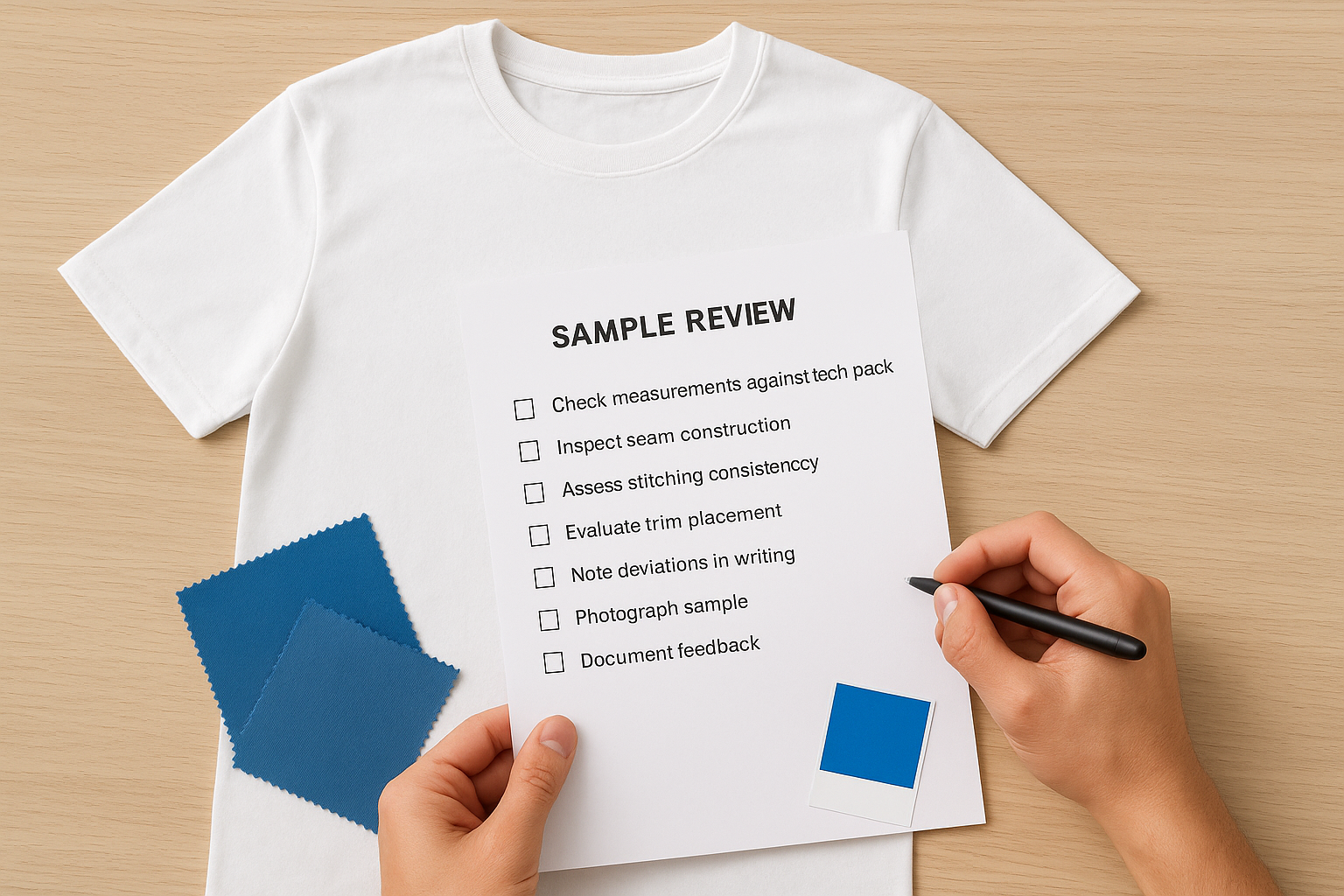
Give clear, numbered feedback rather than general comments like "the fit feels off." Tell the factory exactly what needs to change: "The shoulder seam sits 1.5 cm too far forward" is actionable. "It doesn't look right" is not. Once a sample is approved, lock your specs in a written confirmation that both sides agree to before bulk production starts. That approved sample becomes your production standard, and any deviation from it during bulk is measurable against it.
Step 4. Plan bulk production and shipping
Once your sample is approved and specs are locked, you move into bulk production, and this is where clarity and timing become critical. Many brands lose weeks, and sometimes entire seasons, by assuming the factory will manage everything without a written production plan. Your job at this stage is to confirm every detail in writing before the factory cuts a single piece of fabric.
Confirm your bulk order in writing
Send your factory a production confirmation document that covers every key variable before you release the deposit. This document should reference your approved sample and leave no room for interpretation on quantities, colors, or delivery dates.
Use this bulk order confirmation template as your starting point:
Bulk Order Confirmation Template
- Style reference: [e.g., BLZ-001 Women's Blazer]
- Approved sample date: [Date both parties signed off]
- Total quantity: [e.g., 500 pieces]
- Color and size breakdown: [e.g., 250 black / 250 navy, sizes XS to XL]
- Fabric and trims: [Confirmed specs from approved sample]
- Label and packaging: [Private label, polybag, hangtag details]
- Ex-factory date: [The date goods leave the factory]
- Payment terms: [e.g., 30% deposit, 70% before shipment]
- QC inspection: [Pre-shipment inspection date and standard]
Sending this document before you pay your deposit sets the production standard and gives you a reference point if anything deviates during bulk manufacturing.
Manage lead times and shipping realistically
Bulk production lead times for overseas factories typically run 45 to 90 days from deposit payment, depending on factory workload and fabric availability. Add shipping transit time on top of that, typically 20 to 35 days for sea freight from Asia, and your delivery window becomes real fast. If you're working backward from a sales deadline, build your order timeline before production starts, not after.
Plan for at least one week of buffer time at each production stage to absorb delays without hitting your delivery deadline.
For brands still figuring out how to find a clothing manufacturer and manage the full production cycle, understanding Incoterms is essential. Terms like FOB (Free on Board) and CIF (Cost, Insurance, Freight) determine who pays for what and who carries the risk during international shipment. Confirm your Incoterm with your factory in the bulk order document, and align it with your freight forwarder before goods leave the factory floor.
Wrap-up and your next move
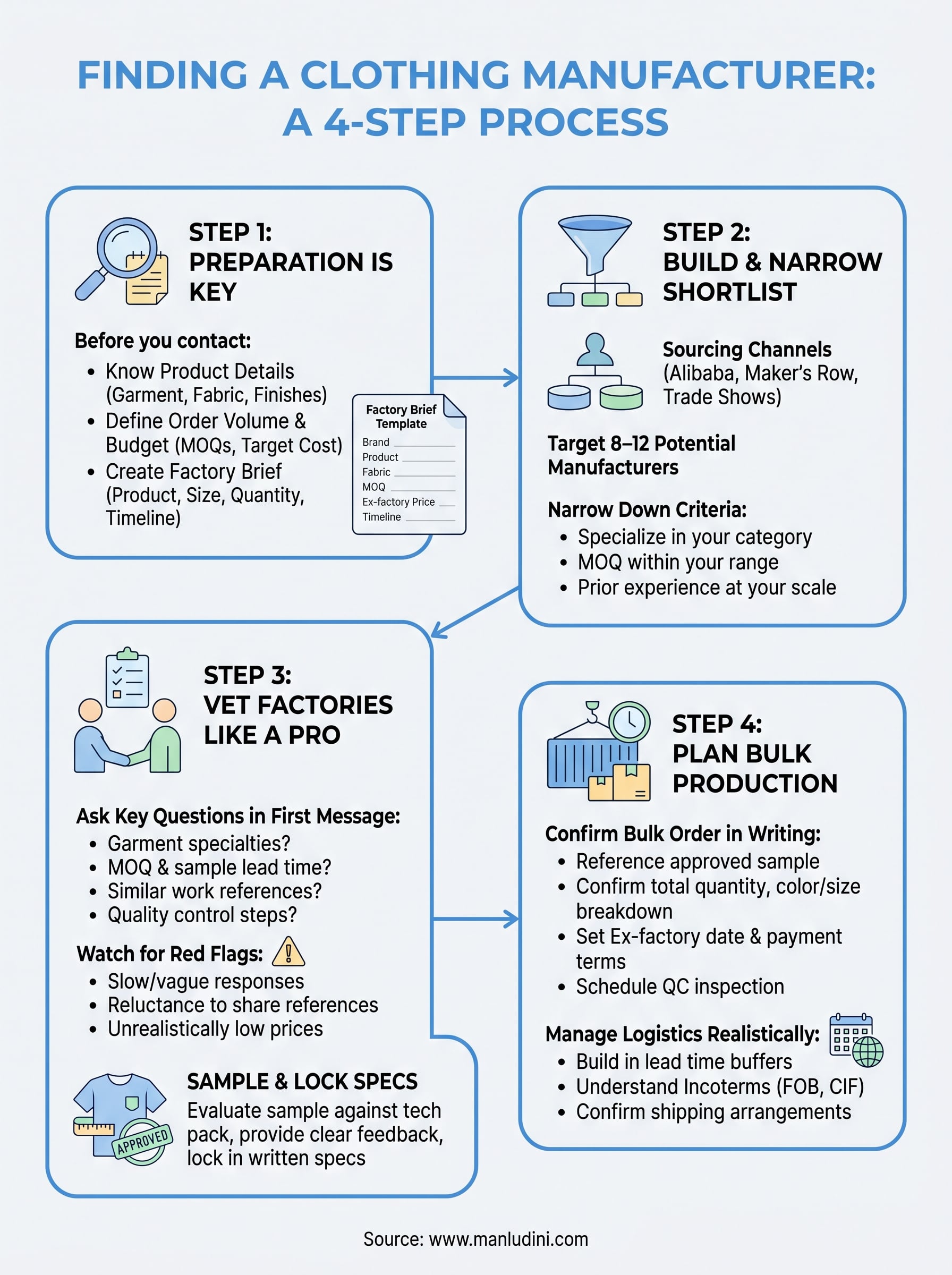
Knowing how to find a clothing manufacturer is really a question of process. You prep your specs and order details before reaching out, build a shortlist of realistic candidates, vet each factory through direct questions and sample rounds, and confirm every bulk production detail in writing before any money moves. Each step builds on the last, and skipping one almost always creates problems two stages down the line.
Finding the right production partner takes time, but it is one of the most important decisions you'll make for your brand. The factory you choose shapes your product quality, your lead times, and your margins from the very first order.
If you're ready to move from research into actual production, get in touch with Manludini to discuss your project. Share your garment details, your target quantities, and where you are in development, and we'll take it from there.
0 comments