
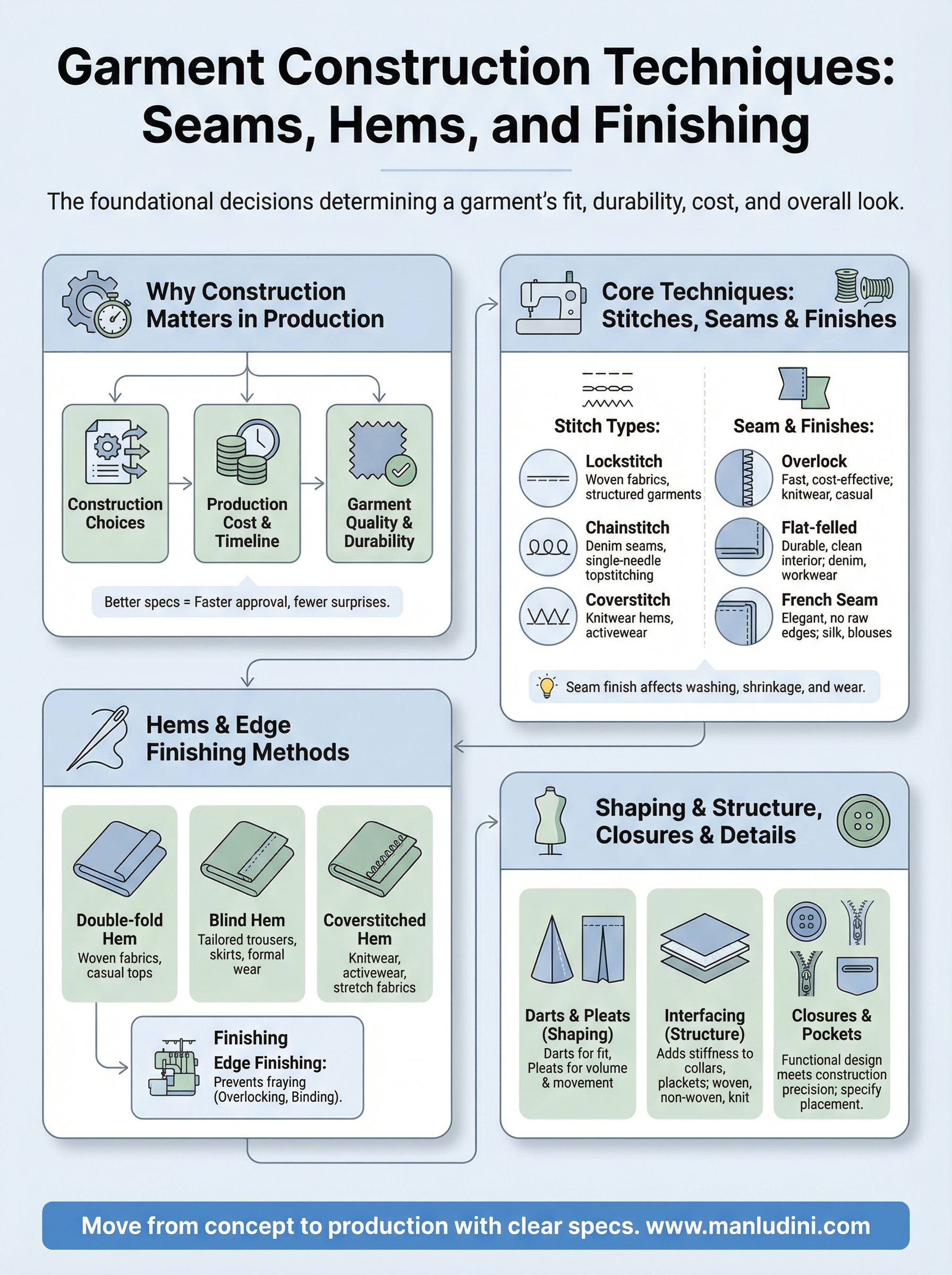
Every finished garment is the result of dozens of decisions made at the construction level. How a seam is sewn, how a hem is folded, how edges are finished, these details determine whether a piece holds up after repeated wear and washing or falls apart within weeks. Understanding garment construction techniques gives brands and designers the ability to communicate clearly with manufacturers, make informed material choices, and set realistic quality expectations before production begins.
At Manludini, we work with fashion brands through every stage of production, from sample development to bulk manufacturing. A large part of that process involves choosing the right construction methods for each garment. Seam types, hem finishes, and closure details aren't just technical footnotes. They directly affect fit, durability, cost, and the overall look of a finished product. When brands understand these fundamentals, the development process moves faster and the results are more consistent.
This article breaks down the core techniques used in garment assembly: seams, hems, shaping methods, closures, and finishing details. Whether you're building your first collection or refining your tech packs for a new season, this guide covers what each technique does, how it's applied, and when to use one method over another.
Why garment construction techniques matter in production
Construction decisions made early in development shape everything that follows: how long sampling takes, how much the garment costs to produce, and how well it performs after repeated use. Every seam type, hem finish, and closure method carries a different labor requirement and material cost, so the choices you make on a tech pack translate directly into your production budget and timeline.
The most common reason brands go over budget or miss approval rounds is poor communication around construction details, not fabric sourcing.
How construction choices affect production cost
Different garment construction techniques require different machinery, skill levels, and time per unit. A flat-felled seam, for example, takes longer to sew than a simple overlocked seam but adds significant durability and a clean interior finish. If your tech pack calls for that seam on every panel of a denim jacket, your factory needs to factor in the additional labor cost per piece. Understanding these trade-offs early helps you make decisions that match your target price point without giving up quality where it counts.
Here is a quick comparison of three common seam types by cost and application:
| Seam Type | Labor Cost | Best Use |
|---|---|---|
| Overlock | Low | Knitwear, casual styles |
| Flat-felled | Higher | Denim, workwear |
| French seam | Moderate | Woven blouses, silk garments |
How construction quality affects your brand
A garment that fits well on a hanger but fails at the seams after five washes creates a real problem for your business. Customer returns, negative reviews, and lost reorders are direct consequences of under-specifying construction at the development stage. When you match the right techniques to each fabric type and end use, you build a product that holds up to the standard your customers expect.
Partnering with a manufacturer who understands construction requirements from the start reduces revision rounds and lowers the risk of bulk production errors. The more clearly you define these details before sampling begins, the smoother your entire production process becomes.
Core building blocks: stitches, seams, and seam finishes
Before you can specify any garment, you need to understand the three foundational elements that hold every piece together: stitches, seams, and seam finishes. Each one performs a distinct function, and selecting the wrong combination for your fabric or end use creates problems at the bulk production stage that are expensive to fix.
Stitch types and their functions
Stitch selection determines the strength and stretch behavior of a sewn joint. A lockstitch works well on woven fabrics but has no give, making it unsuitable for stretch materials. Chainstitch and coverstitch constructions are standard in knitwear because they stretch with the fabric and recover without breaking. Here are the three most common stitch types by application:
- Lockstitch: woven fabrics, structured garments
- Chainstitch: denim seams, single-needle topstitching
- Coverstitch: knitwear hems, activewear
Seams and seam finishes
Your seam choice controls both the structural integrity and the interior appearance of a garment. A plain seam is fast and cost-effective, but the raw edges need a finish to prevent fraying. Overlocking, binding, and Hong Kong finishes are three common approaches, each carrying different labor costs and results.
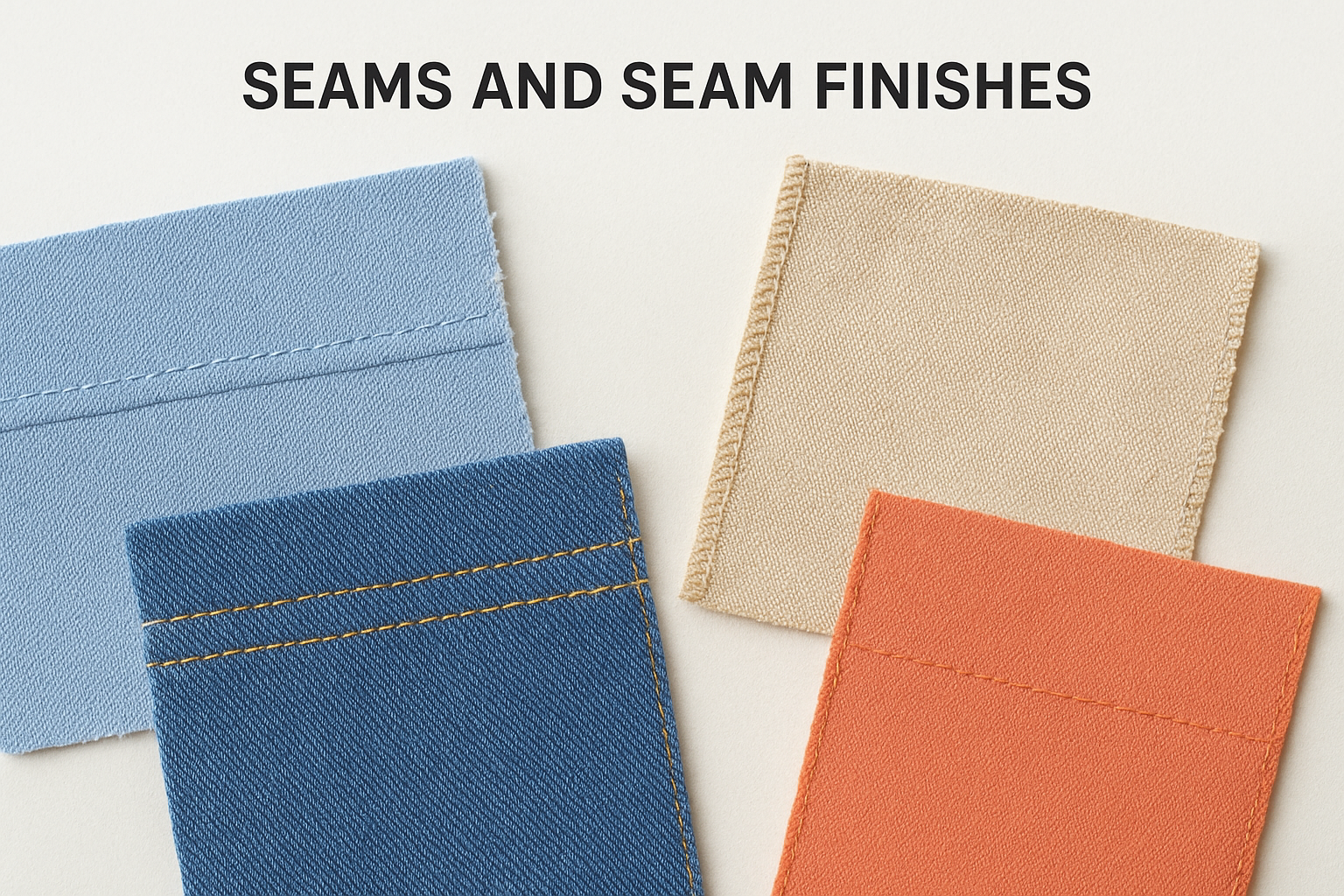
Specifying your seam finish on a tech pack is one of the simplest ways to prevent rejected samples and extra revision rounds.
Applying the right garment construction techniques at this level also determines how your garment handles washing, shrinkage, and repeated wear over its lifetime. The finish you choose needs to match both your fabric type and your target price point, or it creates quality problems in bulk.
Hem techniques and edge finishing methods
The hem is one of the last construction steps, but it's one of the most visible on the finished piece. A poorly executed hem signals low quality immediately, while a well-specified one reinforces the overall garment construction techniques you've defined throughout the rest of the garment. Choosing the right hem method depends on your fabric type, garment end use, and target price point.
Types of hems and when to use them
Not every hem works on every garment. Fabric type and end use determine which method fits best. Here are three common options you'll encounter in production:
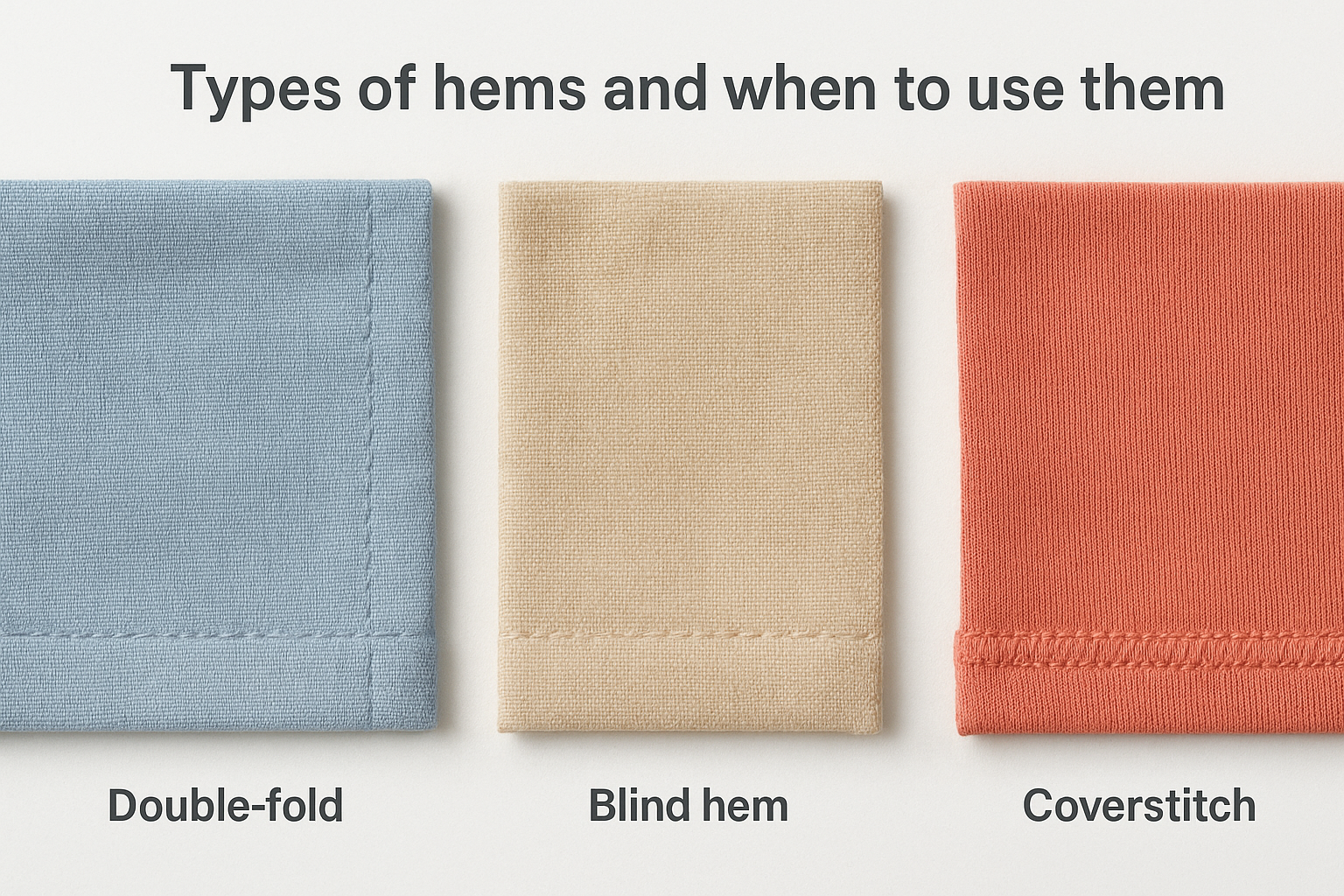
- Double-fold hem: woven fabrics, casual tops, shirts
- Blind hem: tailored trousers, skirts, formal wear
- Coverstitched hem: knitwear, activewear, stretch fabrics
Matching your hem type to your fabric before sampling prevents rework and keeps your revision rounds short.
Edge finishing methods for clean results
Raw edges on woven fabrics need a finish to prevent fraying during wear and washing. Overlocking is the fastest and most cost-effective option for most casual styles. Binding adds a clean, visible edge and works well on unlined jackets, outerwear, and activewear where the interior stays exposed.
Hong Kong binding wraps the seam allowance in fabric tape and suits higher-end woven garments where interior finish quality matters to the end customer and justifies the additional labor cost per unit.
Shaping and structure: darts, pleats, interfacing
Flat fabric doesn't naturally conform to the human body. Darts, pleats, and interfacing are the construction tools that give a garment its three-dimensional shape, and specifying them correctly on your tech pack is one of the most direct ways to control fit and silhouette before a single sample is cut.
Darts and pleats for fit control
Darts remove excess fabric and redirect it into contoured shape. Bust darts, waist darts, and shoulder darts each serve a specific fitting purpose, and the placement of each one must be precise or the fit fails across the board. Pleats work differently: they add controlled volume and movement rather than removing it. Here are three common pleat types and their applications:
- Box pleat: structured skirts, workwear trousers
- Knife pleat: formal skirts, tailored garments
- Inverted pleat: back panels on jackets, performance wear
Getting dart placement right at the sample stage saves you from fit corrections during bulk production.
Interfacing and its role in structure
Interfacing is a supporting layer bonded or sewn to fabric to add stiffness and stability in areas that need to hold their shape under wear. Collar stands, waistbands, and front plackets are standard applications. Choosing between woven, non-woven, and knit interfacing depends on your base fabric and the level of structure required. These garment construction techniques work together to produce a finished piece that looks intentional and holds its shape wash after wash.
Closures, pockets, and clean internal finishing
Closures, pockets, and interior finishing are where functional design meets construction precision. Specifying each one correctly on your tech pack determines how the finished garment performs for the end user, and how much time your factory spends per unit during production. Getting these details right during development keeps your bulk production running on schedule without costly revision rounds.
Closure types and placement
The closure you choose changes both the assembly process and the labor cost. Invisible zippers require more careful insertion than exposed zippers and work best on dresses and skirts where a clean finish matters. Buttons, snaps, and hooks each add different assembly steps, so your choice needs to be specified precisely on your tech pack to avoid inconsistencies across bulk units.
Common closure types by end use:
- Invisible zipper: dresses, tailored skirts
- Button and buttonhole: shirts, jackets, trousers
- Snap or hook-and-eye: waistbands, outerwear closures
Specifying closure placement in millimeters rather than approximating removes one of the most common sources of sample rejection.
Pockets and internal finishing
Pockets add construction complexity that brands often underestimate before sampling begins. Welt pockets, patch pockets, and inseam pockets each carry different labor and skill requirements, so your pocket choice needs to match your target price point directly.
Clean internal finishing, including taped seams, lining choices, and label placement, rounds out the full set of garment construction techniques that define a production-ready garment. Specifying these details on your tech pack before sampling starts keeps your revision rounds short and your bulk production consistent.
Next steps for your production
Understanding garment construction techniques gives you a real advantage before production starts. Seam choices, hem methods, and closure specifications all need to land on your tech pack before sampling begins, or you'll spend extra revision rounds correcting details that should have been defined upfront. Every decision at the construction level connects directly to your production cost, garment quality, and timeline.
Taking these fundamentals into your next development conversation with a manufacturer puts you in a stronger position to get samples approved faster and bulk production running on schedule. Brands that arrive at sampling with well-specified construction details move through revision rounds faster and protect their per-unit cost. Clearer specs mean fewer surprises, and fewer surprises mean lower costs across the full development cycle.
When you're ready to move from concept to production with a team that understands these details, reach out to Manludini to talk through your garment requirements and start building a production plan that works for your brand.
0 comments