
Miscommunication during production usually starts with one thing: unclear terminology. When a brand sends a tech pack that says "clean finish" but the factory interprets it differently, you end up with costly revisions and wasted time. A solid grasp of garment construction terminology is what separates a smooth production run from a frustrating one, whether you're developing your first sample or scaling into bulk manufacturing.
At Manludini, we work with fashion brands through every stage of production, from sample development to finished goods. We've seen firsthand how knowing the right terms speeds up communication with factories, reduces errors, and keeps projects on schedule. That's exactly why we put this reference together, to give you practical, factory-floor language you can actually use.
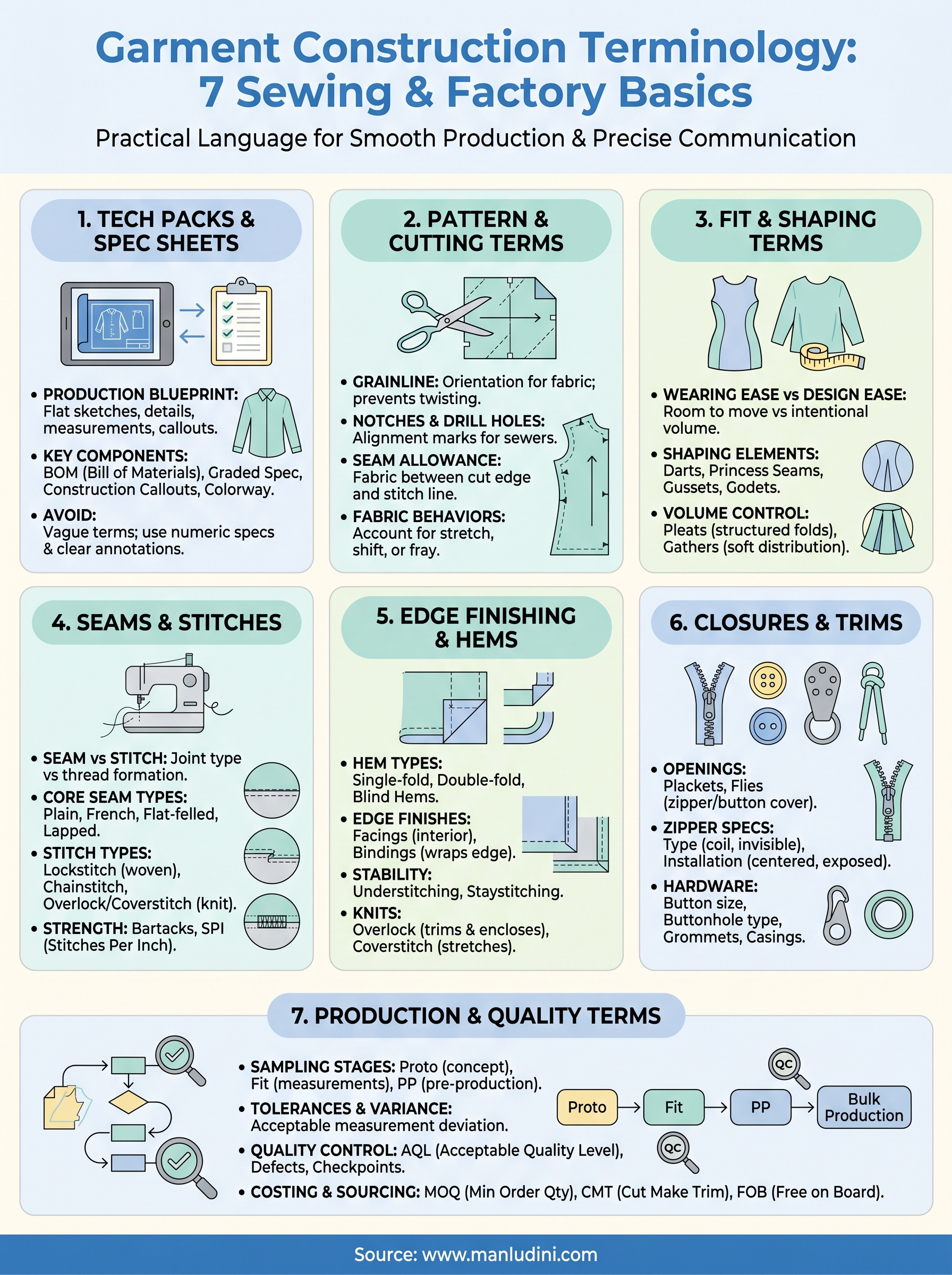
Below, you'll find seven core categories of sewing and manufacturing terms broken down in plain language. Each section covers terminology you'll encounter when working with pattern makers, sewers, and production teams, so you can communicate with precision from day one.
1. Tech pack and spec sheet terms
A tech pack, short for technical package, is the primary document you send to a factory when requesting a sample or bulk production run. It holds all the technical information a factory needs to build your garment correctly the first time. Understanding the garment construction terminology inside this document matters because factories quote, sample, and produce directly from it, and unclear language costs you time and money.
What it means and why factories rely on it
A tech pack functions as your production blueprint. It typically includes flat sketches, construction details, measurements, and written callouts for every component of the garment. Factories use it to set up patterns, source materials, and build the first sample. Without a complete tech pack, factories fill in the gaps with their own interpretation, which rarely matches what you had in mind.
A tech pack with missing or vague callouts is the single most common reason for sample rejections in apparel production.
Key terms to define on every style
Each tech pack should document specific technical fields that leave no room for guessing. The most important ones to include are:
- BOM (Bill of Materials): A complete list of every fabric, lining, interlining, trim, thread, and accessory in the garment, with supplier references where available
- Graded spec: The full measurement chart across all sizes in your run, not just the base size
- Construction callouts: Written or illustrated notes that specify seam types, stitch types, and finishing methods on each part of the garment
- Colorway: The color options for a style, typically referenced by a Pantone number or confirmed through lab dip approval
How to write it clearly in a tech pack
Your callouts should be specific enough that a sewer who has never worked with your brand can build the garment without asking follow-up questions. Use clear sketch annotations and numeric measurement tables rather than written descriptions alone. Number each callout and tie it directly to the flat sketch so production teams can cross-reference without confusion.
Common miscommunications to avoid
Vague language creates expensive production problems. Saying "soft hand" without specifying a fabric weight or finish gives factories too much room to interpret. Always use numeric specs and concrete reference standards when describing construction expectations. Avoid terms like "standard" or "normal" because what one factory considers standard may differ significantly from what another factory does.
2. Pattern and cutting terms
Pattern and cutting language forms the foundation of garment construction terminology that every brand needs to understand before working with a factory. Mistakes at the cutting stage are difficult to fix and often result in twisted seams, misaligned panels, or wasted fabric.
Grain, grainline, and why pieces twist
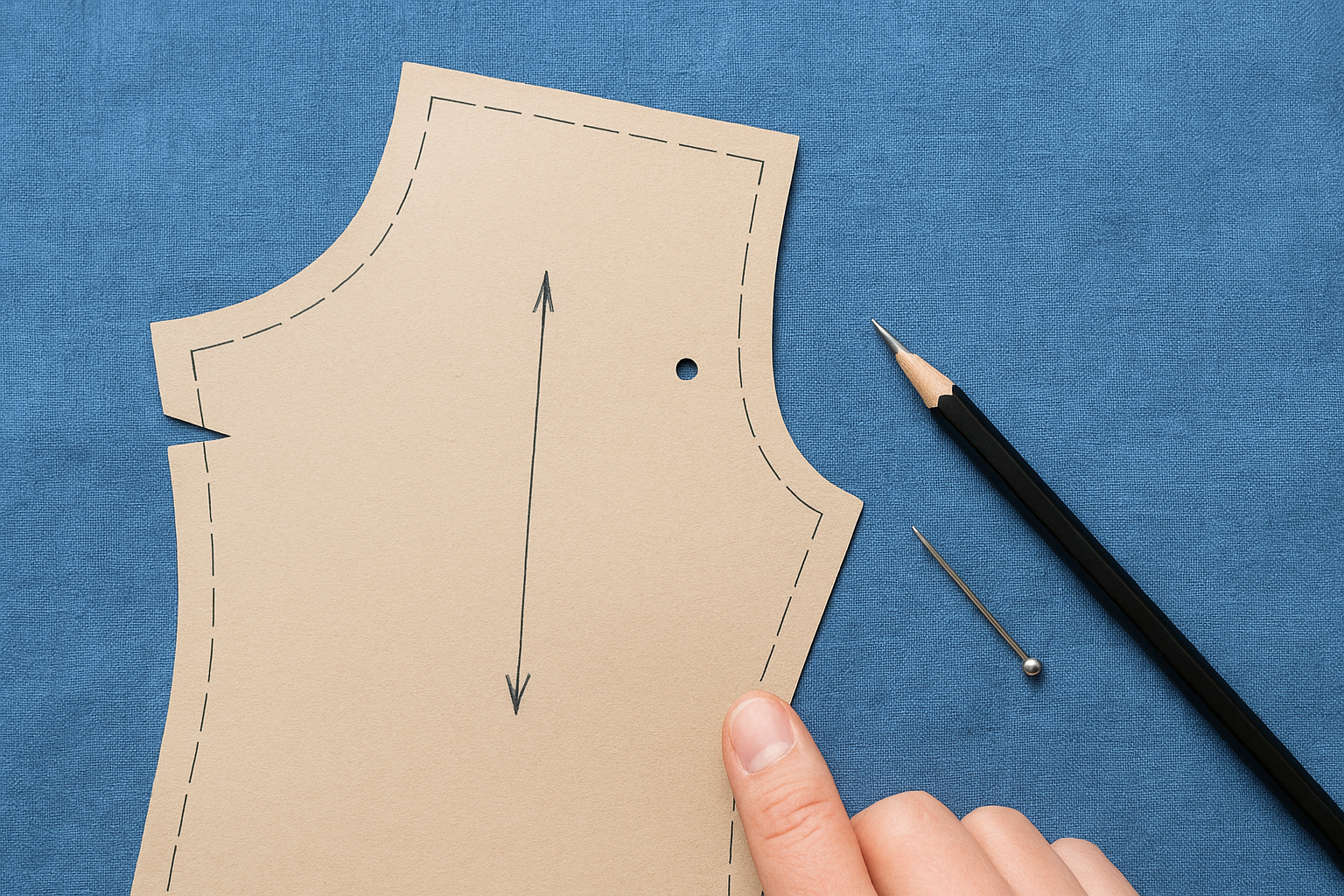
The grainline is an arrow printed on each pattern piece that tells the cutter how to orient the piece on the fabric. When cutters ignore the grainline or it is missing from your pattern, fabric pieces end up off-grain, which causes seams to twist or garments to pull sideways after washing.
Off-grain cutting is one of the most common causes of fit complaints in bulk production, and it is entirely avoidable with a clearly marked pattern.
Notches, drill holes, and match points
Notches are small v-shaped marks cut into the seam allowance to help sewers align two pieces before stitching. Drill holes mark interior alignment spots like dart tips or pocket placement. Both must appear on your pattern to avoid misaligned construction in the final garment.
Seam allowance and cutting lines
Seam allowance is the fabric between the cut edge and the stitch line. Factories often work with a default allowance, but you need to confirm this in your tech pack. A cutting line shows exactly where scissors or a cutting blade should follow on each pattern piece.
Fabric behaviors that affect cutting
Some fabrics shift, stretch, or fray during cutting. Slippery wovens like satin need weight or pins to hold layers flat, while knit fabrics require specific cutting methods to prevent edge curl that throws off your measurements.
3. Fit and shaping terms
Fit terms make up a significant part of garment construction terminology that brands often overlook until samples come back wrong. Understanding how factories and pattern makers talk about shape and fit helps you write better callouts and give clearer feedback during the sampling process.
Ease, wearing ease, and design ease
Wearing ease is the amount of extra fabric built into a garment beyond the body measurement, giving you room to move and breathe. Design ease is additional volume added intentionally for a specific silhouette, like an oversized fit. Both need to be specified in your tech pack so the pattern is graded correctly from the start.
Confusing wearing ease with design ease is one of the most common reasons brands get samples back with the wrong fit.
Darts, princess seams, and shaping options
Darts are folded and stitched fabric triangles that remove fullness and shape a flat piece of fabric to a three-dimensional body. Princess seams achieve similar shaping through vertical seam lines running from shoulder to hem, allowing more precise contouring without a dart fold. Your choice between the two affects both the fit and the construction complexity of the final garment.
Gussets, godets, and adding mobility
A gusset is a triangular or diamond-shaped fabric insert added at stress points like underarms or crotch seams to improve movement. A godet is a triangular panel inserted into a seam or slash to add flare at the hem.
Pleats, gathers, and controlling volume
Pleats are folds of fabric stitched at one end to control fullness in a structured way, common in trousers and skirts. Gathers distribute excess fabric evenly along a seam for a softer, draped effect. Your callout should always specify which method to use and where it is placed on the garment.
4. Seams and stitches you will hear daily
Seam and stitch language is some of the most frequently used garment construction terminology in factory communication. When you can describe exactly what you want at each seam, factories build it right the first time without back-and-forth revisions.
Seam vs stitch and how to talk about both
A seam is the joint where two or more fabric pieces are sewn together, while a stitch refers to the individual thread formation that creates that joint. Factories need you to specify both in your construction callouts because the seam type determines structure and the stitch type determines strength and stretch.
Core seam types used in production
The most common seam types you will encounter are plain seams, French seams, flat-felled seams, and lapped seams. Plain seams are the default in most woven garments. Flat-felled seams, common in denim, enclose the raw edge within the seam itself for added durability and a clean interior finish.
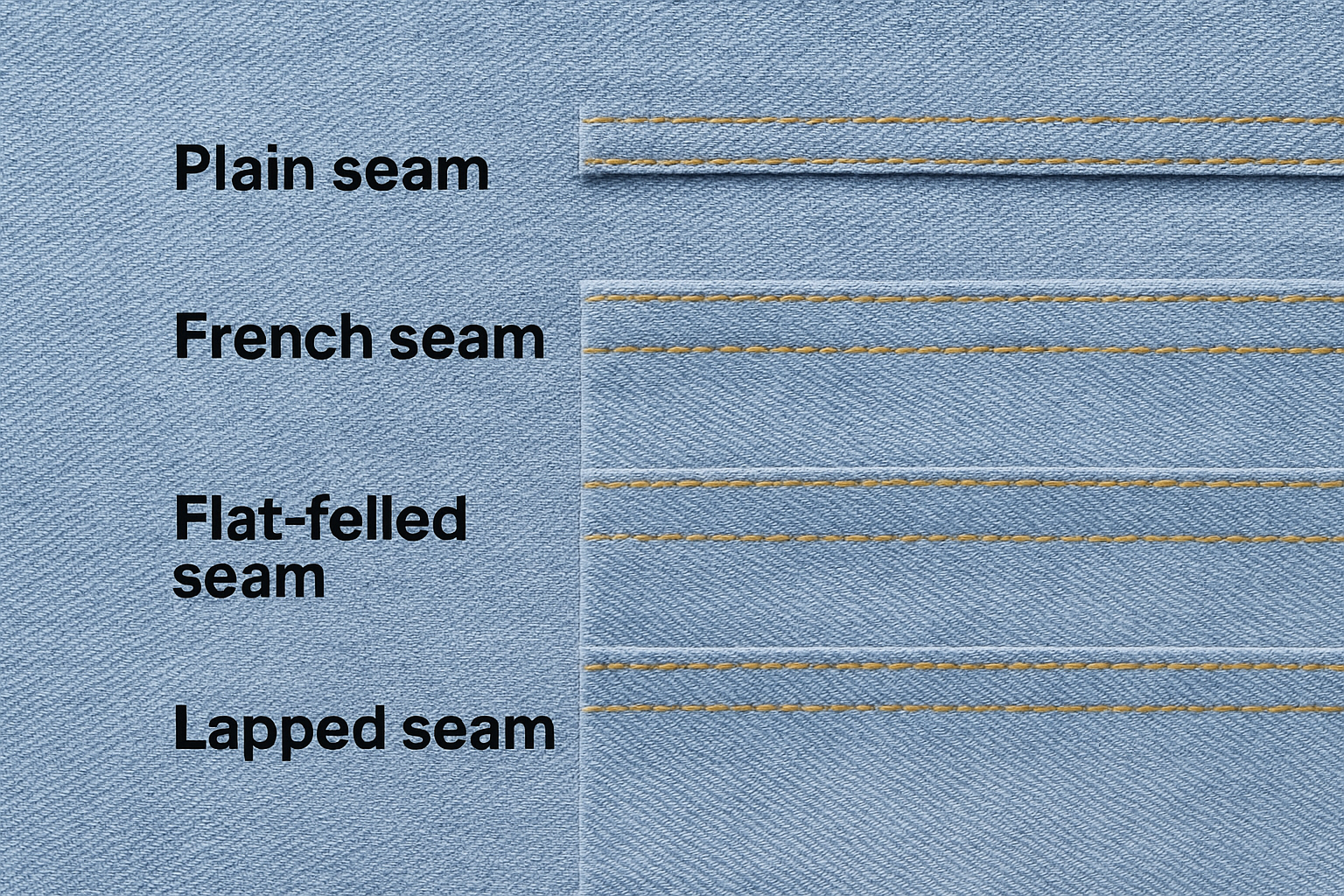
Calling out your seam type specifically in your tech pack removes the factory's need to guess, which reduces sample revisions significantly.
Stitch types and when to use each
Lockstitch (301) is the standard stitch for woven fabrics, while chainstitch (401) offers more elasticity and is faster to produce. Knit fabrics typically require a coverstitch or overlock to allow the seam to stretch without breaking under wear.
Strength terms like bartacks and SPI
A bartack is a cluster of tight stitches reinforcing high-stress points like pocket corners and belt loops. SPI (stitches per inch) measures stitch density, and higher SPI generally produces a stronger, more polished seam finish.
5. Edge finishing and hem terms
Edge finishing controls how raw fabric edges are treated in your garment. This part of garment construction terminology covers hem types, neckline finishes, and edge stability techniques. Getting callouts right prevents puckering, fraying, and inconsistent construction across your production run.
Hem types and when each makes sense
Your hem choice affects both the look and the durability of a finished garment. A single-fold hem turns the edge under once, while a double-fold hem turns it twice to enclose the raw edge completely. Topstitched hems suit casual styles, while blind hems work better in tailored garments where visible stitching would break a clean finish.
Facings, bindings, and clean finishes
A facing is a shaped fabric piece sewn to a garment edge and flipped to the inside to hide the raw edge. A binding wraps the edge on both sides and is stitched in place, common on activewear necklines and armholes.
Specifying whether you want a facing or binding on each edge avoids factory assumptions that can change your garment's look significantly.
Understitching, staystitching, and stability
Understitching is a row of stitches through the facing and seam allowances that keeps the facing rolled to the inside. Staystitching is sewn before assembly to prevent curved or bias edges from stretching out of shape during construction.
Overlock and coverstitch language for knits
Knit garments need finishes that stretch with the fabric. An overlock stitch trims and encloses the raw edge in one pass, preventing fraying and adding elasticity. A coverstitch uses two parallel needle threads on the face with looper threads on the back, making it the standard for knit hems on jersey and activewear styles.
6. Closures and trim terms
Closures and trims are part of the garment construction terminology that directly affects both function and finished appearance. Factories need precise callouts for every opening and fastening in your garment, because ambiguous instructions lead to incorrect hardware sourcing and assembly errors that delay your samples.
Plackets, flies, and garment openings
A placket is a finished fabric opening that allows a garment to be put on or taken off, typically reinforced with a facing or band. A fly covers a zipper or button closure at the front of trousers or shorts. Spec out both the opening width and the finish method in your tech pack so the factory builds each opening to the correct structure.
Zipper types and installation callouts
Your tech pack should specify the zipper type (coil, invisible, or molded tooth) along with the installation method: centered, lapped, or exposed. Each method changes the construction sequence the factory follows and affects the external appearance of the finished garment.
Always call out zipper brand and pull style to prevent substitutions that alter the finished look of your garment.
Buttons, buttonholes, snaps, and hooks
Specify button diameter and attachment method in your BOM. State whether the buttonhole is machine-cut or bound, since this changes construction time and reflects the overall quality level of the style.
Grommets, drawcords, elastics, and casings
A casing is a fabric tunnel that holds elastic or a drawcord. Always specify elastic width and stretch recovery so the factory builds every opening consistently across your full production run.
7. Production and quality terms that affect build
Production and quality language rounds out the garment construction terminology you need to communicate effectively with any factory. These terms appear from the first sample request through to final shipment, and knowing them precisely helps you set expectations, catch problems early, and avoid expensive surprises at the end of a production run.
Sampling stages and approval language
Most factories move through a defined sampling sequence before bulk production begins. Each stage locks in a specific layer of approval, and you need to confirm each one in writing before the factory proceeds:
- Proto sample: Tests concept, proportions, and overall direction
- Fit sample: Confirms all measurements against your spec sheet
- PP (pre-production) sample: Finalizes materials, construction, and trims before bulk cutting begins
Tolerances, measurements, and acceptable variance
Measurement tolerances define how far a finished garment can deviate from your spec sheet before it is considered out of spec. Confirm your acceptable variance in writing with the factory before production starts to avoid disputes when garments arrive slightly off measurement.
Setting your tolerances before bulk production removes ambiguity and gives your QC team a clear standard to inspect against.
Defects, QC checkpoints, and AQL basics
AQL (Acceptable Quality Level) is a statistical sampling standard that defines how many defective units are acceptable within a production batch. Factories and buyers use AQL 2.5 as the common benchmark for general apparel, which determines how many units an inspector randomly checks and how many failures trigger a full rejection.
Costing and sourcing terms like MOQ, CMT, and FOB
Three terms appear in almost every factory conversation. MOQ (minimum order quantity) sets the floor for how many units a factory will produce per style. CMT (cut, make, trim) means you supply the fabric while the factory handles production. FOB (free on board) defines the point where shipping responsibility shifts from the factory to you, which directly affects your landed cost calculations.
Where to go from here
You now have a working foundation in garment construction terminology across every stage of the production process, from tech packs and pattern work through to QC and costing. That knowledge directly reduces back-and-forth with factories, shortens your sampling cycle, and helps you catch costly problems before they reach bulk production.
The next step is putting this language to work. Whether you are developing your first sample, refining a fit across sizes, or moving into bulk production for the first time, having the right manufacturing partner makes a significant difference. At Manludini, we work directly with brands to turn tech packs and ideas into finished garments, with clear communication and reliable execution at every step.
If you are ready to start a project or want to learn more about how we support brands from sampling through to bulk shipment, contact the Manludini team and tell us what you are building.
0 comments