
Jersey knit is one of the most widely used fabrics in apparel production, and for good reason. Understanding jersey knit fabric properties helps you make smarter decisions during development, from choosing the right weight for a T-shirt to knowing how a fabric will behave after washing. Whether you're building your first collection or refining an existing line, these properties directly affect fit, comfort, and overall garment performance.
At Manludini, we work with fashion brands through every stage of production, from sample development to bulk manufacturing. Fabric selection is one of the earliest and most consequential steps in that process, and jersey knit comes up constantly. We've seen firsthand how a solid grasp of fabric behavior saves time, reduces sampling rounds, and leads to better finished garments.
This article breaks down the key physical and performance characteristics of jersey knit fabric, stretch, drape, breathability, recovery, and more. You'll walk away with a clear picture of how jersey knit behaves, what makes it suitable for specific garment types, and how to evaluate it with more confidence when planning your next production run.
Why jersey properties matter in garment design
When you're designing a garment, fabric choice shapes everything from how the finished piece looks on a body to how it holds up after repeated washing. Jersey knit is not a single, uniform material. It comes in different weights, fiber compositions, and structures, and each variation carries a distinct set of physical behaviors that directly influence your design decisions. Choosing the wrong jersey for a given application doesn't just affect aesthetics. It affects fit, durability, and how the garment performs across its entire lifespan.
Getting jersey properties wrong at the sampling stage means you'll likely need additional development rounds before the fabric performs the way you intended, which adds cost and extends your timeline.
How fabric properties affect fit and sizing
Jersey's stretch and recovery are the two properties that most directly affect fit. A fabric that stretches well but doesn't recover loses its shape quickly, which means a T-shirt that fits well on day one looks worn out by day ten. When you understand how much stretch a jersey offers in both directions, you can size your patterns appropriately and reduce the number of fit corrections during sampling. This translates directly into fewer prototypes and a more predictable development process.
Breathability and fabric weight also play into how a garment fits and feels on the body. A heavy jersey with low breathability works well for a structured sweatshirt but will feel uncomfortable in a fitted athletic top. Knowing these details before you finalize your tech pack gives your pattern maker and factory a clear starting point, rather than leaving those decisions to interpretation.
The connection between properties and production decisions
Jersey knit fabric properties don't just affect the end user. They affect every step of your production process. Fabrics with high stretch require different cutting methods, sewing needle sizes, and stitch types. If you send a tech pack to a factory without specifying the right fabric behavior, you create room for misinterpretation, which leads to delays, rework, and added sampling costs.
Your factory needs to know the GSM (grams per square meter), fiber content, and stretch percentage to prepare accurate production samples. A lighter jersey at 140 GSM behaves completely differently on a cutting table and a sewing machine than a heavier, denser option at 280 GSM. The more clearly you define these requirements upfront, the smoother your entire production run will be, from cutting room to final quality check.
How jersey knit is made and why it behaves that way
Jersey knit is created by interlocking loops of yarn in a single continuous structure, typically on a circular or flat knitting machine. Unlike woven fabrics, which cross threads at right angles, jersey is built from connected loops that move with each other. That structural difference is the root cause of almost every property you'll encounter when working with this fabric.
The loop structure and what it creates
The interlocked loop construction gives jersey its natural stretch in multiple directions, most noticeably across the width. When you pull on a jersey fabric, those loops simply elongate rather than resist, which is why the material feels so pliable compared to a woven twill or canvas. This also explains the characteristic curl at raw edges, a common issue during cutting and sewing that your factory needs to account for when processing jersey panels.
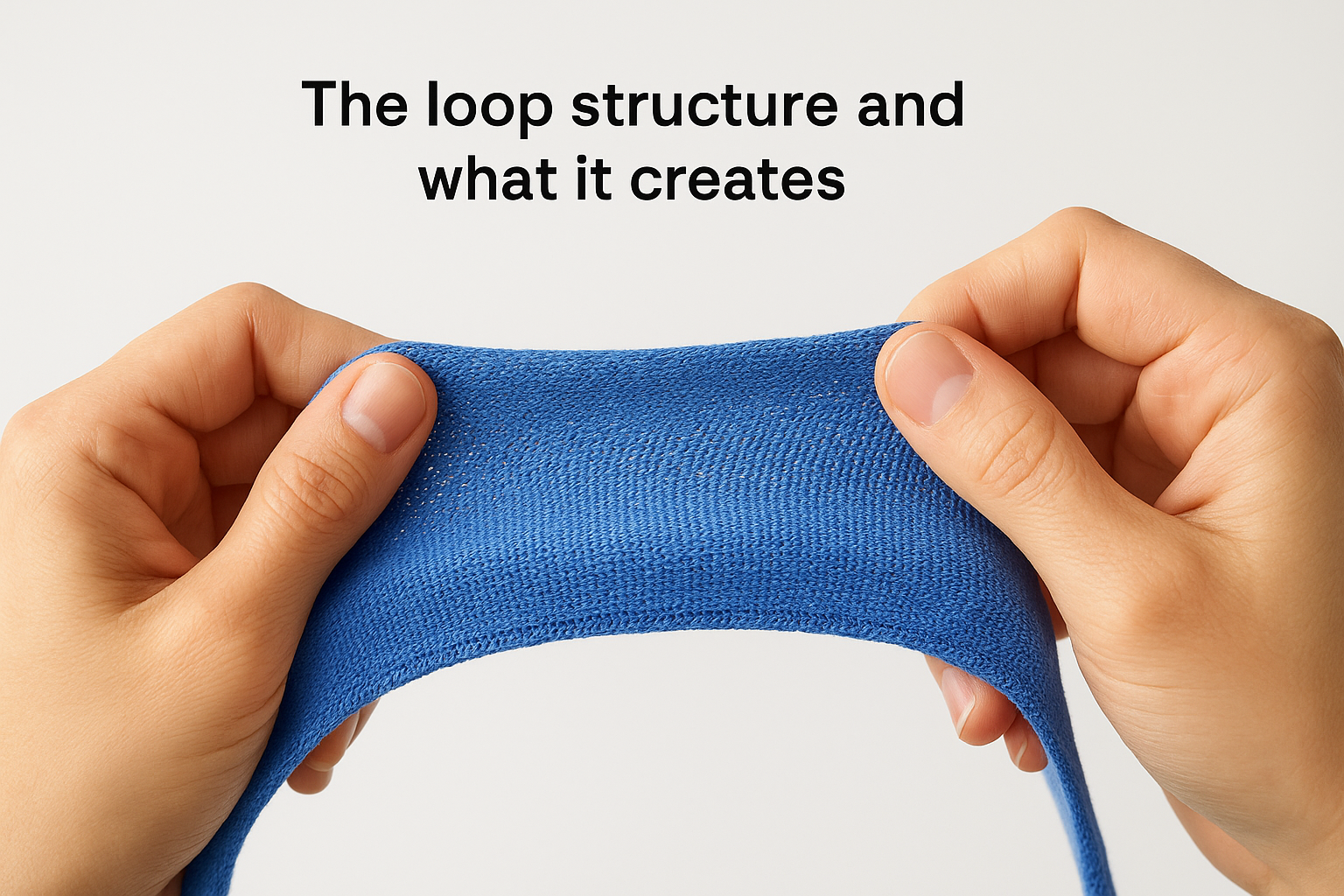
Understanding this loop behavior upfront is what allows you to plan correctly for seam allowances, stitch selection, and edge finishing in your tech pack.
How yarn type and tension affect behavior
The fiber content and yarn twist used in jersey production directly influence how the finished fabric performs. A tightly spun cotton yarn produces a firmer, denser fabric with less stretch, while a loosely spun yarn or a blend incorporating elastane creates a softer, more elastic result. Knitting tension also plays a role. Higher tension produces a tighter, more structured fabric, and lower tension creates a lighter, more open hand feel. When you're sourcing fabric for a specific product, these variables determine whether the finished jersey knit fabric properties align with what your design actually needs.
Core jersey knit fabric properties explained
Knowing the specific properties of jersey before you commit to a fabric helps you avoid costly corrections during sampling. The jersey knit fabric properties that matter most in garment development fall into three areas: mechanical performance, comfort, and dimensional stability. Understanding each one gives you a clearer starting point when specifying fabric for your tech pack.
The more precisely you define these properties upfront, the fewer rounds of sampling you'll need before your factory delivers the right result.
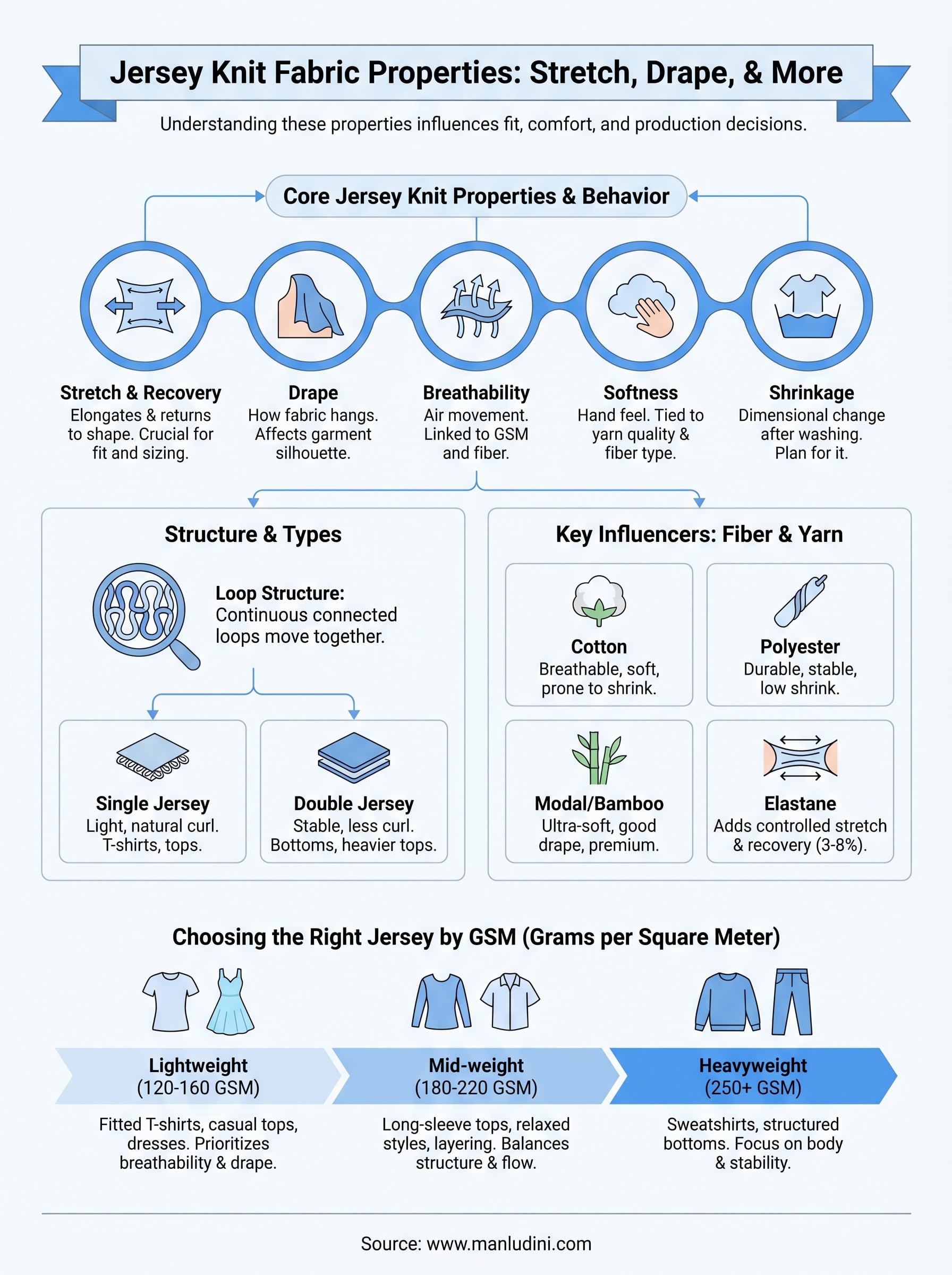
Stretch, recovery, and drape
Stretch is jersey's most distinctive characteristic. The fabric extends across the width and in most cases offers some give lengthwise as well. When you pull on a jersey panel and release it, recovery determines how completely it returns to shape. Low recovery means visible distortion after wear, bagging at the knees or elbows, and a garment that loses its silhouette faster than expected.
Drape works closely alongside stretch. A lighter jersey with a looser structure flows and moves with the body, which suits tops and dresses. A denser, heavier jersey holds its shape better and works well for structured bottoms or sweatshirts.
Breathability, softness, and shrinkage
Breathability depends on both fiber content and GSM. A lightweight cotton jersey lets air move through the structure, while a dense synthetic blend retains more heat. Softness is closely tied to yarn quality and fiber type. Cotton and modal blends produce a noticeably softer hand feel than coarser synthetic options.
Shrinkage is the third variable your team needs to plan for. Most jersey knits shrink during the first wash, and your factory needs to either pre-shrink the fabric or adjust pattern dimensions to account for it before bulk cutting starts.
Types of jersey knits and common fiber blends
Not all jersey is built the same. The structure and fiber content of a jersey fabric determine how it performs in production and how it feels on the body. Knowing the difference between jersey types gives you a stronger foundation when specifying materials for your next development round.
Single jersey vs. double jersey
Single jersey is the most common construction. It uses one set of needles to create a fabric with a smooth face and a looped back, giving it a lightweight feel with a natural roll at the edges. It works well for T-shirts, casual tops, and lightweight dresses. Double jersey, on the other hand, uses two sets of needles and produces a thicker, more stable fabric that resists curling and holds its shape better. This makes double jersey a reliable choice for structured bottoms, heavier tops, and garments where edge curl would complicate finishing.
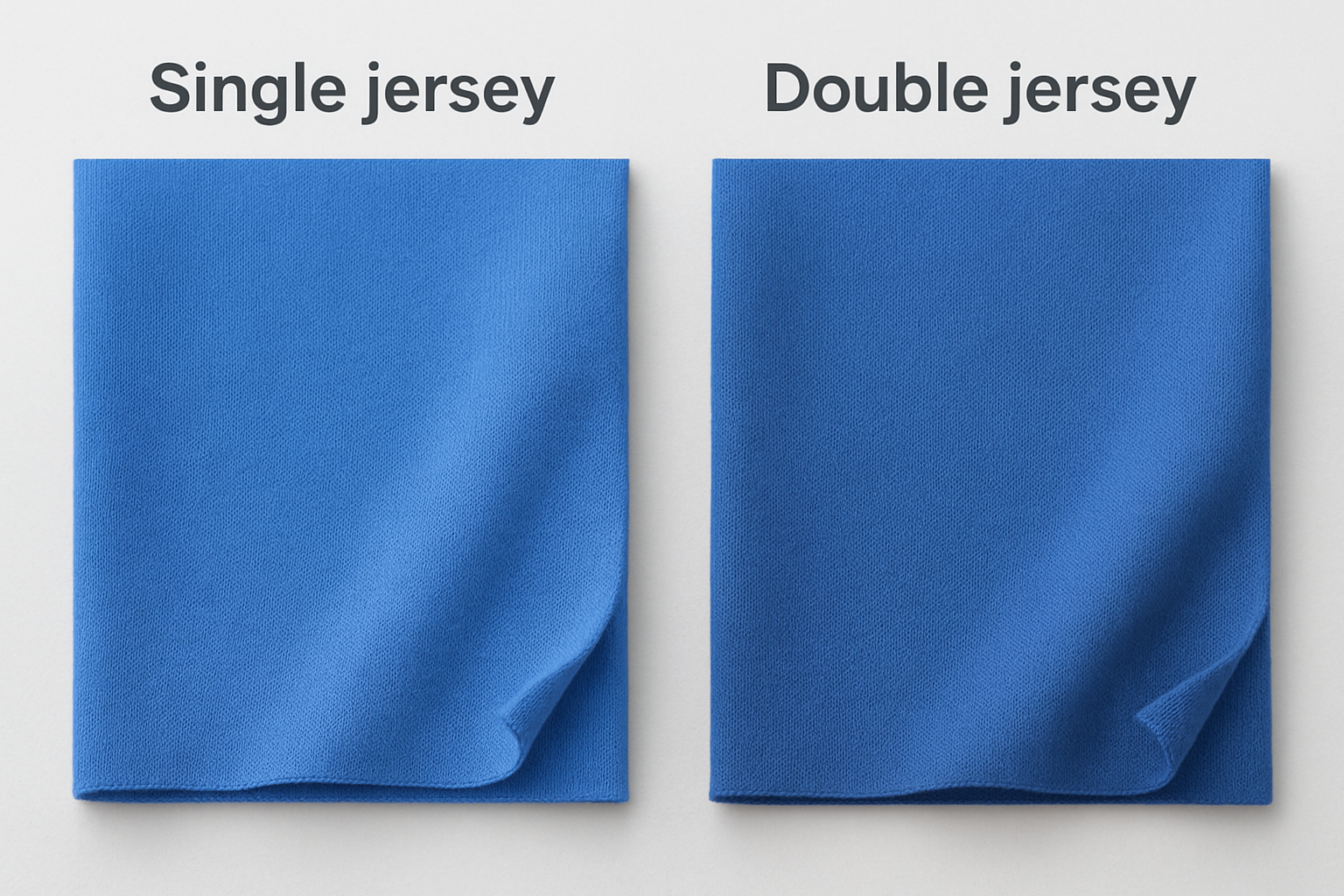
If your garment requires clean-cut edges or minimal distortion during sewing, double jersey is often the more practical choice for your factory to work with.
Common fiber blends and what they add
Jersey knit fabric properties shift noticeably depending on the fiber blend. A 100% cotton jersey is breathable and comfortable but prone to shrinkage and slower recovery. Adding polyester to the blend increases dimensional stability, reduces shrinkage, and improves shape retention after washing. Modal and bamboo blends produce a noticeably softer hand feel, which suits premium basics and loungewear. Elastane, typically added at 3 to 8 percent, introduces controlled stretch and recovery without significantly changing the fabric's overall character. Choosing the right blend means matching fiber behavior to your garment's specific performance requirements.
How to choose the right jersey for your product
Selecting the right jersey starts with understanding what your garment needs to do. A T-shirt worn in warm weather has completely different requirements from a structured sweatshirt or a fitted athletic top. Before you finalize your fabric spec, think through the end-use conditions, fit expectations, and wash durability your customer will experience. That process of matching jersey knit fabric properties to your product requirements is what separates a well-developed garment from one that goes through multiple correction rounds.
Match fabric weight to your garment category
GSM is the clearest starting point when narrowing down your options. Lightweight jersey between 120 and 160 GSM suits fitted T-shirts, casual tops, and summer dresses where breathability and drape matter most. Mid-weight options from 180 to 220 GSM work well for long-sleeve tops, relaxed-fit styles, and layering pieces. Anything above 250 GSM moves into sweatshirt and structured bottom territory, where body and stability take priority over movement.
Specifying your target GSM range in your tech pack gives your factory a measurable starting point rather than leaving fabric weight open to interpretation.
Factor in fiber content and production requirements
Fiber content affects how your factory handles the fabric at every stage, from cutting to finishing. A high-elastane blend requires stretch-appropriate needles and stitch types to avoid skipped stitches or seam breakage. Blends with polyester improve dimensional stability and reduce shrinkage, which simplifies bulk cutting and pre-production planning.
If your garment targets a premium market position, a modal or cotton-modal blend delivers a softer hand feel that supports that expectation. Matching your fiber spec to both your product positioning and production requirements is what keeps your development timeline on track.
Key takeaways and next steps
Jersey knit fabric properties cover a wide range of variables, and each one plays a direct role in how your garment develops, fits, and holds up after repeated wear. Stretch, recovery, drape, breathability, GSM, and fiber content are not abstract specs. They shape every production decision from pattern development through bulk cutting and finishing. The clearer you define these properties in your tech pack, the fewer corrections you'll need during sampling.
Choosing the right jersey means matching fabric behavior to your garment's end use, not just selecting a material that looks similar to a reference sample. When you understand how construction and fiber content affect performance, you give your factory a concrete starting point and reduce the back-and-forth that slows development down.
If you're ready to move a style into production with a manufacturing partner who works directly with you on fabric selection and sample development, contact the Manludini team to get started.
0 comments