
Streetwear went from underground subculture to one of the most influential segments in fashion, and it's not slowing down. If you're figuring out how to start a streetwear brand, you're entering a space where authenticity and identity matter more than big budgets. That's good news if you've got a clear vision and the willingness to put in the work.
But here's what most guides won't tell you: the hardest part isn't coming up with a logo or picking a name. It's bridging the gap between your creative concept and an actual, sellable product. Designing a hoodie in Illustrator is one thing. Getting it sampled, produced, and shipped at the right quality and cost is a completely different challenge, and it's where most new brands hit a wall.
That's the part we know well. At Manludini, we help brands go from tech packs and design ideas to finished garments, handling sample development, fabric sourcing, bulk production, private labeling, and everything in between. We've worked with startups launching their first collection and growing labels scaling into larger runs, so we've seen what works and what trips people up early on.
This guide walks you through every major step: building your brand identity, designing your first pieces, finding the right manufacturer, setting up your business, and getting your streetwear into customers' hands. No fluff, no vague motivation, just a practical roadmap from idea to production and beyond.
What you need before you start
Before you dive into logos, colorways, and drop dates, you need to get a few fundamentals in place. Starting a streetwear brand without these often means redoing work, burning money, or stalling out before your first drop ships. Getting these foundations right early saves you from the most common and costly mistakes that trip up new brands.
Your mindset and time commitment
Learning how to start a streetwear brand takes more than creative energy. It takes sustained effort across design, operations, sales, and manufacturing, sometimes all in the same week. Expect at least 10 to 20 hours per week in your early phase if you're building this alongside another job, and more if you're going full-time.
Accept that your first collection will not be perfect. Samples come back with fit issues, colors shift, and fabrics behave differently than you planned. Your ability to stay focused and iterate quickly is what separates brands that survive from those that fold after one drop, because every brand goes through this adjustment period.
The brands that gain traction aren't always the most creative ones. They're the ones that show up consistently and learn from each production cycle.
Your starting budget
Many founders underestimate what early-stage production actually costs. You don't need a massive budget to start, but you do need a realistic one. Below is a rough breakdown of where your money will go before you ever make a sale.
| Expense | Estimated Range |
|---|---|
| Brand identity (logo, graphics) | $200 - $1,500 |
| Tech pack development | $100 - $500 per style |
| Sampling (per style) | $150 - $400 |
| Bulk production (small MOQ run) | $1,500 - $5,000+ |
| Labels, hangtags, packaging | $200 - $600 |
| E-commerce setup | $50 - $300 |
| Photography | $300 - $800 |
Plan for at least $3,000 to $6,000 to launch a focused capsule of three to five pieces at small quantities. You can launch smaller, but cutting corners at this stage often damages first impressions with buyers and customers before you've had a chance to build any real trust.
Your tools and accounts
You don't need expensive software, but you do need the right set of tools before production work begins. Here's a practical list to have ready before you contact any manufacturer or start sampling.
- Design software: Adobe Illustrator or Photoshop for flat sketches and graphic files. If budget is tight, Canva works for simple graphics but not for technical production files.
- Cloud storage (Google Drive or Dropbox): for organizing tech packs, fabric references, and factory communications in one accessible place.
- A business email address: factories take you more seriously when you contact them from a brand domain rather than a personal Gmail account.
- A registered business entity: a basic LLC protects your personal assets and is required by most payment processors and wholesale buyers.
- An e-commerce platform account: Shopify is the standard for most streetwear brands starting out and integrates with the major fulfillment and payment tools.
- A payment method with available credit: sampling and production both require deposits, often 30 to 50 percent upfront.
Having these in place before you start outreach means you spend your time moving forward instead of scrambling to set up infrastructure while a factory waits on you.
Step 1. Define your customer and your lane
Most new brands skip this step and jump straight to design. That's a mistake. Every design decision, price point, and marketing move you make should trace back to a specific person you're building for, not a vague idea of "streetwear fans." The clearer you are on your customer before you start sampling, the less money and time you burn correcting course later.
Know exactly who you're selling to
You don't need a 30-page marketing document, but you do need a real, detailed picture of your [target customer](https://www.manludini.com/blogs/insights/how-to-develop-a-clothing-brand) before you contact any manufacturer. Think beyond age and location. Consider what your customer listens to, where they shop today, how much they spend on a graphic tee or hoodie, and why they'd choose your brand over what's already in their closet. Getting this specific early saves you from designing pieces that look good on a flat sketch but miss completely with the people you're trying to reach.
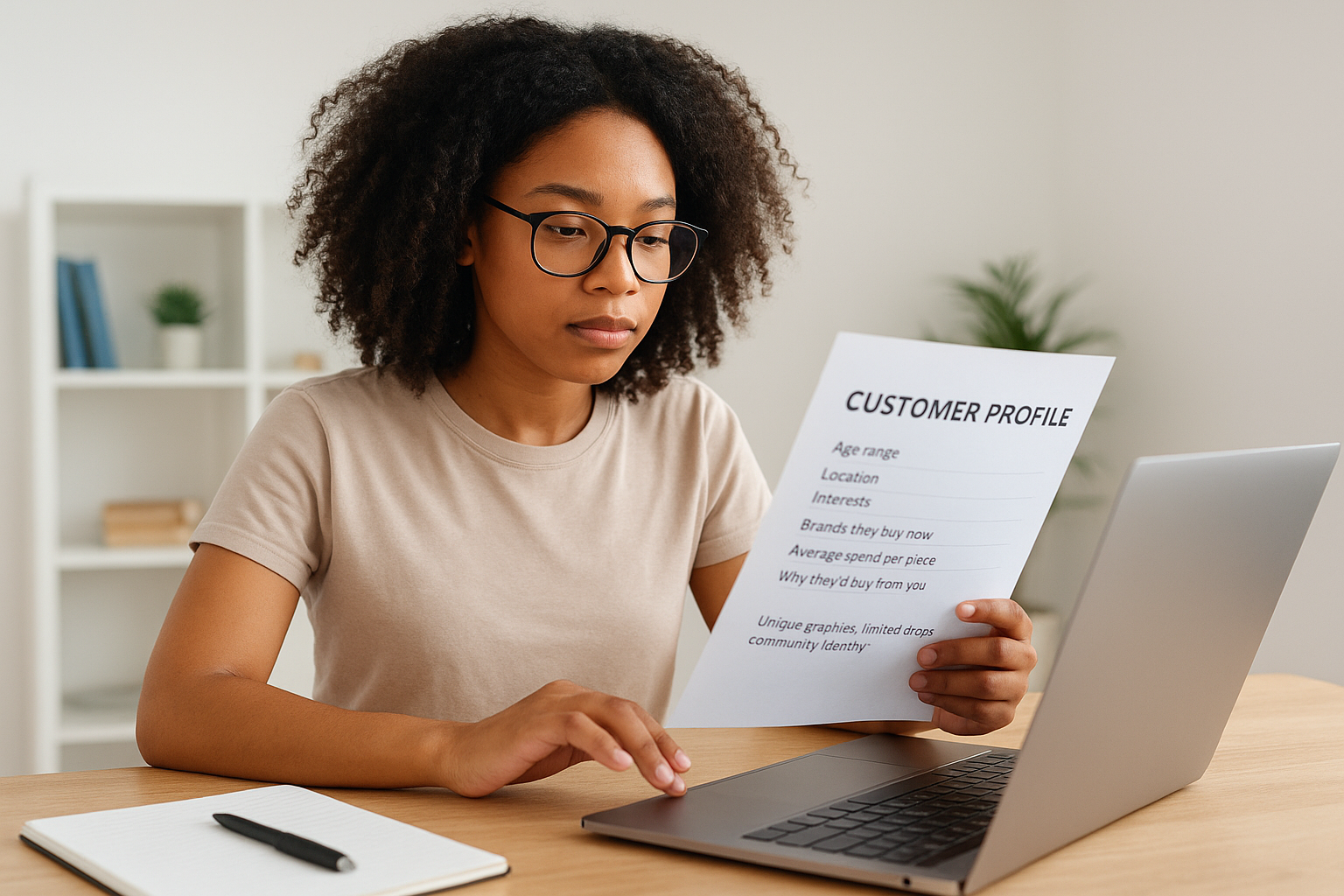
Use this template to build a working customer profile:
| Field | Example |
|---|---|
| Age range | 18 to 28 |
| Location | Urban US, UK, or Australia |
| Interests | Skateboarding, underground hip-hop, sneaker culture |
| Brands they buy now | Carhartt WIP, Palace, local indie labels |
| Average spend per piece | $60 to $120 |
| Why they'd buy from you | Unique graphics, limited drops, community identity |
The more specific your customer profile is, the easier every decision becomes, from fabric weight to drop timing to where you show up online.
Pick your lane and stay in it
Streetwear covers a wide range of aesthetics, and trying to appeal to everyone is the fastest way to connect with no one. Before you finalize your first designs, decide where your brand sits. Are you heavy on large graphics and bold prints? Are you taking a cleaner, workwear-influenced approach? Do you build around a specific subculture like skate, music, or sport? Locking in your aesthetic direction at this stage also makes your conversations with manufacturers far more productive, since you can describe your fabrics, fits, and finishes with real clarity.
Your lane shapes your product, your pricing, and your community in ways that go deeper than visuals alone. A skate-influenced brand targets different retailers, price points, and spaces than a premium streetwear label does. Knowing which side you're on when working through how to start a streetwear brand keeps your first collection tightly focused and your message consistent from day one.
Step 2. Build a brand people want to join
A streetwear brand lives or dies on whether people feel something when they encounter it. Design quality matters, but it's the identity underneath the design that makes someone buy a hoodie and tell their friends about it. Before you get into sampling or production, your brand needs a clear identity that people can connect with, not just a logo sitting on top of a blank garment.
Your name, logo, and visual identity
Your brand name should be easy to say, easy to search, and carry some weight behind it. Avoid generic compound words or names that sound like dozens of other brands already in the market. Once you land on a name, check availability across social platforms, domain registrars, and the USPTO trademark database before you commit anything to samples or packaging.
The logo needs to work at every scale, from a 1-inch woven label to a full front graphic. Keep your primary mark simple enough to embroider or print cleanly at small sizes, and build a secondary graphic system around it for different apparel applications. Use a consistent set of two to three colors across your entire visual identity so your brand stays recognizable across every format and platform it appears on.
Streetwear identity is built through consistency over time. One cohesive visual system applied repeatedly does more than ten different aesthetics competing with each other.
Your brand story and voice
People don't just buy clothes from streetwear brands. They buy into a point of view, a world the brand represents. Your story doesn't have to be complicated, but it does have to be real. Write two to three sentences that explain what your brand stands for, who it's built for, and what separates it from everything else already on the market. Use those sentences as your filter for every product and content decision you make from this point forward.
Your brand voice is how you communicate across product descriptions, social captions, packaging inserts, and direct messages with customers. Decide early whether you're casual and raw, minimal and direct, or something else entirely, and stay consistent with it across every touchpoint. One of the most practical things you can do when working through how to start a streetwear brand is to write down five words that describe your brand's voice and keep them visible while you work.
Step 3. Design your first capsule and drop plan
Your first collection should be tight and intentional, not a broad catalog trying to cover every style direction at once. A focused capsule of three to five pieces lets you control quality, manage production costs, and build real demand before you scale. This is one of the most important decisions you make when working through how to start a streetwear brand, because a focused debut gives you cleaner data on what actually resonates with your customer.
Build a focused capsule
A capsule works best when every piece belongs to the same world. Start with one or two core items, typically a heavyweight graphic tee and a fleece hoodie or crewneck, then add one or two supporting pieces that extend the same aesthetic. Every item in the capsule should share consistent color, graphic language, and fit direction so the collection reads as a cohesive set rather than a loose grouping of individual products.
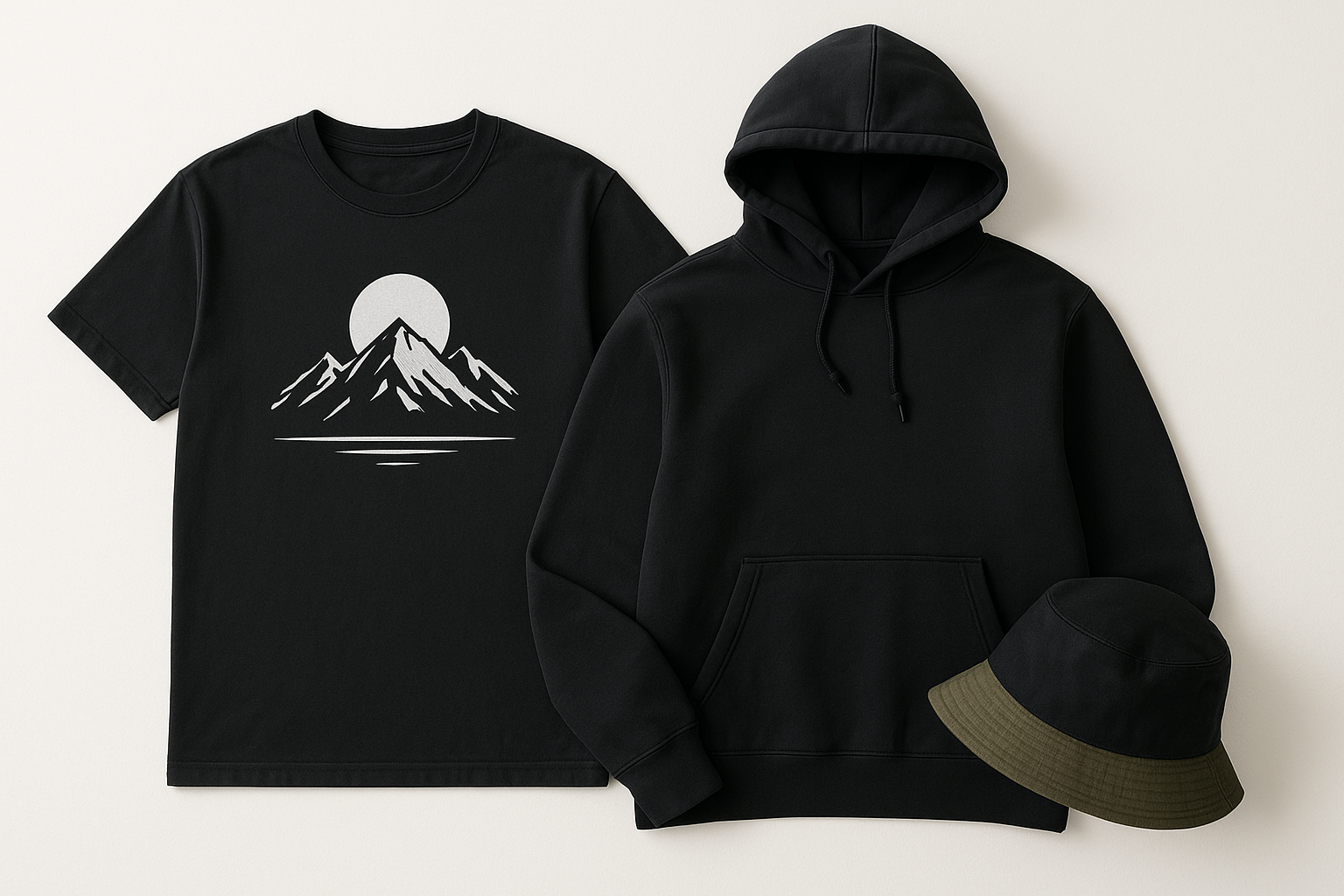
Use this template to map out your first capsule before you move into design files:
| Style | Category | Colorways | Target Retail Price |
|---|---|---|---|
| Graphic tee | Core | Black, off-white | $55 - $75 |
| Heavyweight hoodie | Core | Black, stone | $110 - $140 |
| Bucket hat | Accessory | Black/olive | $45 - $60 |
A tight capsule forces you to make deliberate choices, and deliberate choices produce collections that feel like they belong together.
Plan your drop before production starts
Your drop plan should exist before you place your first sample order. Decide on your launch date, your quantity per style, your pricing, and where customers will buy before you commit to any production deposit. Working backward from a target launch date gives you real deadlines to hold your manufacturer to and prevents the common mistake of rushing production just to hit a date you picked after sampling was already in progress.
Build a simple drop plan that covers four things: launch date, quantity per style, primary sales channel, and pre-launch content schedule. If you're planning a limited drop, decide upfront whether you're selling through your own store, a pop-up, or a combination of both. Knowing your channel before production finalizes also helps you confirm packaging requirements and labeling needs early enough to avoid delays that push your launch back by weeks.
Step 4. Turn designs into production-ready tech packs
A tech pack is the document that turns your design concept into something a factory can actually build. Without one, every detail of your garment is open to interpretation, and manufacturers will fill in the gaps with whatever is standard for them, not what you envisioned. This step is where learning how to start a streetwear brand shifts from the creative side into the technical side, and getting it right determines whether your samples come back close to your vision or need to be rebuilt from scratch.
What goes into a tech pack
A complete tech pack covers every measurable and visual detail of a garment so that nothing is left to guesswork. Each document should be specific to a single style, never shared across multiple pieces, because fits, construction details, and trims differ between a tee, a hoodie, and a jacket.
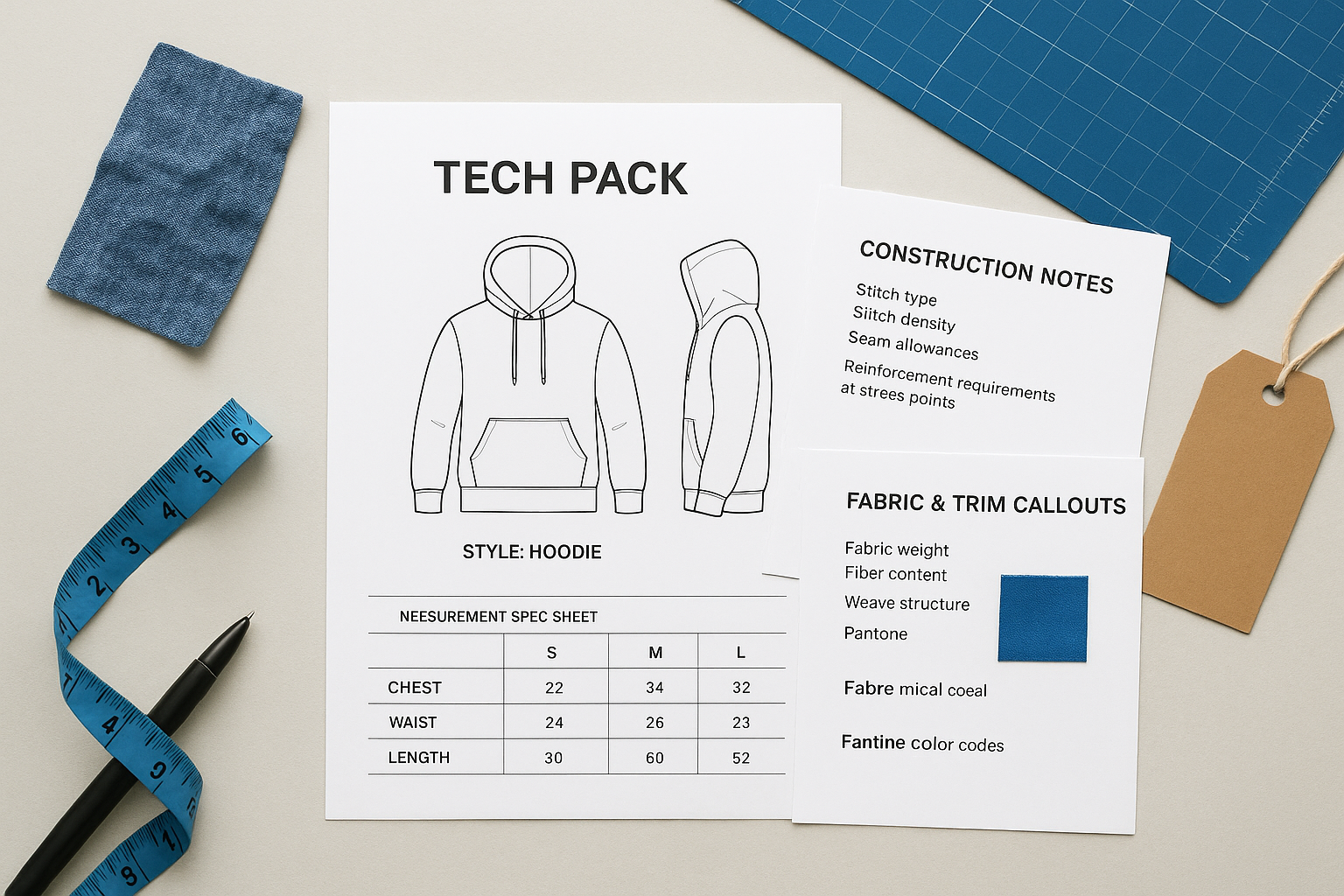
Here are the core components every tech pack needs to include:
- Flat sketch: front, back, and side views drawn to scale with all seam lines, pocket placements, and hardware visible
- Measurement spec sheet: a full graded size chart with all points of measure listed in both centimeters and inches
- Construction notes: stitch type, stitch density, seam allowances, and any reinforcement requirements at stress points
- Fabric and trim callouts: fabric weight, fiber content, weave structure, and Pantone color codes for each material used
- Label and packaging specs: placement, size, and attachment method for all care labels, brand labels, and hangtags
- Graphic artwork files: print dimensions, placement coordinates, and color separation files in vector format
A tech pack is your quality control document before production even starts. The more specific it is, the fewer rounds of sampling you need.
Build your tech pack before you contact any factory
Contacting a manufacturer without a tech pack wastes your time and theirs. Factories quote based on what they can actually measure and assess, so showing up with only a sketch and a mood board means any quote you get back is just a guess.
If you're not building tech packs yourself, hire a freelance technical designer to produce them before you reach out to anyone for sampling. Provide your reference garments, flat sketches, and detailed notes, and confirm that every spec sheet includes a complete measurement table. Arriving at the sampling stage with clean, complete documentation cuts your back-and-forth with the factory in half and gives you a real benchmark to check every sample against.
Step 5. Sample, choose a manufacturer, and go to bulk
Sampling is where your brand becomes real, and it's also where most founders make avoidable mistakes by rushing the process or choosing a manufacturer based on price alone. Getting this step right is one of the most critical parts of learning how to start a streetwear brand, because the decisions you make here directly shape your product quality, your margins, and your relationship with the factory you'll depend on going forward.
Find and vet the right manufacturer
Start with manufacturers who specialize in the garment types you're producing. A factory that excels at cut-and-sew fleece may not be the right fit if your capsule is built around woven jackets. Ask any potential manufacturer for references, photos of past work, and minimum order quantities before you send them a single tech pack.
When evaluating a manufacturer, use this checklist to filter quickly:
- Communication speed: are they responding within 48 hours and answering your questions directly?
- Sampling capability: can they produce samples in your exact fabric weights and constructions?
- MOQ flexibility: do their minimums align with your planned launch quantities per style?
- Quality documentation: can they provide fabric certifications, wash test results, or inspection reports on request?
- Export experience: do they handle export documentation and customs paperwork for your destination country?
Choosing the right manufacturer early saves you from switching mid-production, which almost always delays your launch and costs more than getting the decision right the first time.
Review your samples and move to bulk
When your first sample arrives, check it against your tech pack spec sheet line by line before giving any feedback. Measure every point of measure, review the construction at the seams and stress points, and assess the color match against your Pantone callouts. Document every correction in writing with photos attached, and send a single consolidated revision note rather than a series of back-and-forth messages.
Most styles require at least two sample rounds before they're bulk-ready, so build that into your timeline from the start. Once a sample is approved, confirm your bulk order in writing with a clear breakdown of quantities per style, colorway, and size, plus agreed delivery dates and payment terms. Lock in your packaging and labeling details at this stage as well, so labels, hangtags, and polybags are ready when production finishes and you're not waiting on trims to ship.
Wrap-up
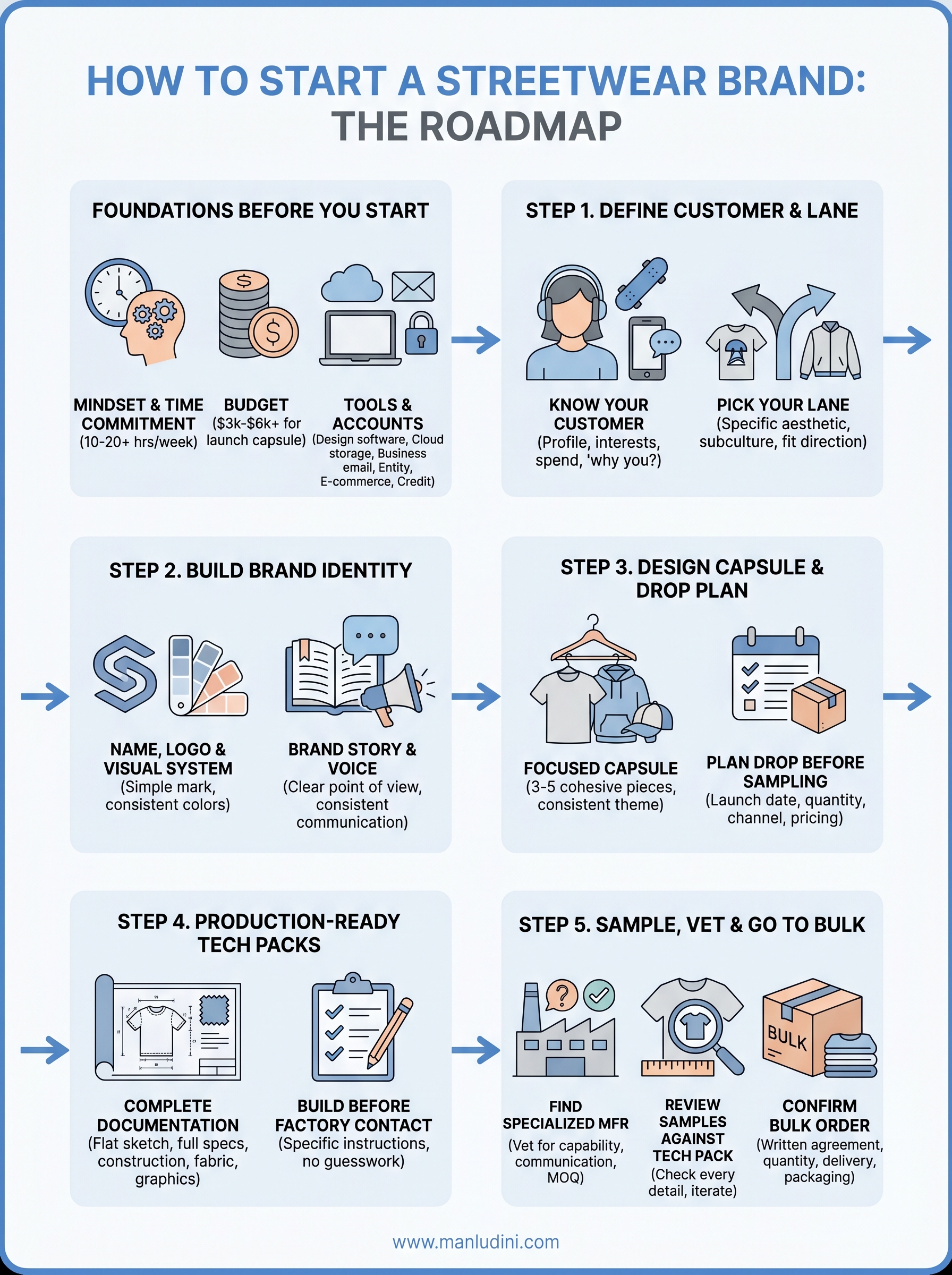
Every step covered in this guide builds on the one before it, so skipping ahead usually means coming back to fix gaps that slow down your production and your launch. Knowing how to start a streetwear brand means knowing how to move in the right order: customer first, identity second, design third, tech packs fourth, and manufacturing last. That sequence exists because each stage informs the next, and cutting corners at the front creates expensive problems at the back.
The manufacturing side is where many brands lose momentum, but it doesn't have to be that way. Working with a manufacturer who communicates clearly, handles sampling properly, and supports your labeling and packaging needs makes a real difference in how your first collection comes out. If you're ready to move from designs to production, reach out to the Manludini team and let us help you get your first drop built right.
0 comments